Developed by Agentic Personnel LLC
Your website ranks,
your socials attract,
your trust factor multiplies,
your reviews compound,
all from one playbook.
The brand authority layer your SEO team can't build. The agentic social operation no agency offers. The roofing-specific website infrastructure that ranks every town you serve and gets you cited in ChatGPT and Google AI Overviews. One stack. One bill. One throat to choke.

| Line item | Setup | Monthly |
|---|---|---|
| Peak Growth Web | $4,200 | — |
| Peak Growth Playbook | $12,400 | $4,200/mo |
| Scoreboard Dashboard | $3,200 | — |
| Peak Growth Media Director | $12,400 | $3,800/mo |
| Full stack | $32,200 | $8,000/mo |
targeting 100–300/mo by year 2 in a healthy rollout
designed to outperform 5–10% on cold outbound
aiming across organic, paid, and referral with disciplined execution
Your game plan, in four minutes.
Most roofing-contractor websites are a brochure that happens to live on the internet. They get rebuilt every three years, sit at the bottom of search results, and have nothing wired up to the rest of the marketing operation. Peak Growth Roofing is the alternative — a marketing operation you can run like a football team. A playbook of ten owned systems on offense. A shared scoreboard where your sales reps engage on the same field every day. A live dashboard where you and your team can see — in five seconds, from anywhere — exactly what's winning, what's losing, and where to push next.
Three products, one operation, every play wired into the same scoreboard. Peak Growth Web is the front door — a portable kit of SEO, answer-engine, and AI-search infrastructure that ranks every town you serve independently and gets you cited by ChatGPT and Google AI Overviews. Peak Growth Playbook is the local-authority layer — ten systems handling Google Business, technical SEO, project proof, reviews, conversion tracking, citations, and a live Gamified Dashboard. Peak Growth Media Director is the agentic media operation — eight specialized AI agents on a server you own, publishing every weekday, running paid campaigns, and tracking AI-citation visibility across five engines.
Every credential, every byte, every post is owned by you. Full transparency — every play, every yard, every point on the scoreboard. If our relationship ever ends, you keep the entire system and run it without missing a post.
What this system is designed to do, what it needs from your team, and what you will own from day one.
This system is designed to do three things: build owned authority, increase qualified inbound opportunities, and make the marketing operation portable and visible instead of locked inside a vendor. The operating targets below are directional, not guaranteed. In a healthy rollout, the goal is to move this brand from zero-review / low-authority footing toward a credible trust position, a review base that compounds, and an inbound lead flow that grows from owned channels instead of relying only on paid leads.
What this system is aiming at
- ReviewsTarget 50+ Google reviews at 4.5+ stars in the first 6–9 months, with consistent use of the review engine. Zero-review footing today; credible local trust base as the goal.
- Leads30–80 inbound leads per month from organic, maps, referral, and supporting paid channels in year one. Designed to scale higher in year two as authority compounds.
- ConversionTarget a healthier inbound close rate than cold outbound by improving trust signals, response time, and attribution discipline.
- CostReduce dependency on high-cost PPC/LSA-only acquisition by increasing owned discovery channels that compound without ongoing spend.
- OwnershipAll critical credentials, infrastructure, and reporting access transferred into the client's control as each system is wired in — substantially complete by the end of the build window.
How we plug your team into the system
Two halves below. The marketing engine bullets (imagery, authority layer, point of contact) are what we run as part of the engagement. The optional sales-team integration bullets (speed-to-lead scoreboard, CRM wiring) are interesting capabilities you can plug your reps into when you're ready — they're offered, not assumed.
- →5-minute speed-to-lead, gamified. Optional sales-team integration. The system is built around the industry's 5-minute SLA (Harvard/MIT research). If you want to plug your reps in, we wire response time into the scoreboard (+3 for hits, −3 for misses, business hours respected) and let the leaderboard run itself. If your sales team prefers to keep their own workflow, the marketing engine still runs without it.
- →Project imagery pipeline. We set up the photo-capture flow on your crew side so job photos, trucks, and team shots feed the content engine automatically.
- →Authority + trust layer. Owner bios, team pages, licenses, service-area copy. We build it once with your input, and the system maintains it.
- →CRM wiring. Optional sales-team integration. Lead source fields, sales outcomes, attribution loops — if you want closed-revenue tied back to the originating marketing channel, we wire your CRM into the dashboard. If you'd rather keep CRM data separate, the marketing engine still reports on traffic, leads, and review velocity without it.
- →Internal point of contact. We need one person on your side we can ping for approvals and photo drops. That's the only ongoing ask.
How the marketing system connects to your sales team
Marketing will not just generate leads — it will improve how leads are routed, tracked, and learned from. The dashboard is designed to evolve toward booked inspections and closed revenue, not stop at traffic metrics.
- →Lead stages defined clearly: new → contacted → set → sat → closed → lost
- →Reps onboarded to lead context — where the lead came from, what pages they saw, what objections to expect
- →Dashboard tracking booked inspections and closed jobs where CRM data is available — not just form fills and clicks
- →Monthly review compares marketing quality and sales follow-through, so missed revenue is not blamed blindly on either side
What the company owns on day one
This is not a license. This is a transfer of control.
- ✓The website, codebase, and hosting — under accounts in the company's name
- ✓All data, dashboard access, and analytics — directly accessible, not filtered through a vendor
- ✓Social accounts, GBP, Search Console, and GA4 — company accounts, Agentic Personnel as authorized admin
- ✓VPS, AI agents, content archive, and credentials map — on infrastructure the company controls
- ✓If the relationship ends, the company keeps the machine and can hand it to another competent operator without rebuilding from scratch
For this roofing company, Peak Growth is designed to replace a traditional SEO / digital marketing retainer with an owned, AI-aware growth system built under the company's control.
| Function | With a traditional agency retainer | With Peak Growth |
|---|---|---|
| SEO and local visibility | Typically outsourced to a vendor with unclear ownership and black-box processes. | Replaced by Peak Growth Web + Peak Growth Playbook — infrastructure the company owns and can verify. |
| Reporting | Monthly PDFs and partial visibility. Source data stays in the agency's tools. | Live Gamified Dashboard with direct access to underlying data — plus a real monthly recap PDF with a local-competitor scout report. |
| Social publishing | Manual, ad hoc, or missing. Output depends on a human account manager's availability. | Replaced by Peak Growth Media Director — agentic publishing every weekday with a structured editorial calendar. |
| Reviews and GBP operations | Often inconsistent. Review requests depend on the service team remembering to ask. | Replaced by systematic Peak Growth Playbook operations — a structured review engine, GBP management, and authority compounding. |
| AI-search visibility | Usually not built as a first-class function. Most agencies are still catching up to what this requires. | Built directly into the stack as a core infrastructure layer — not a future add-on. |
| Credentials and continuity | Held by the agency. If the relationship ends, rebuilding is the only path forward. | All credentials transferred to the company on day one. Any competent operator can continue the work without a rebuild. |
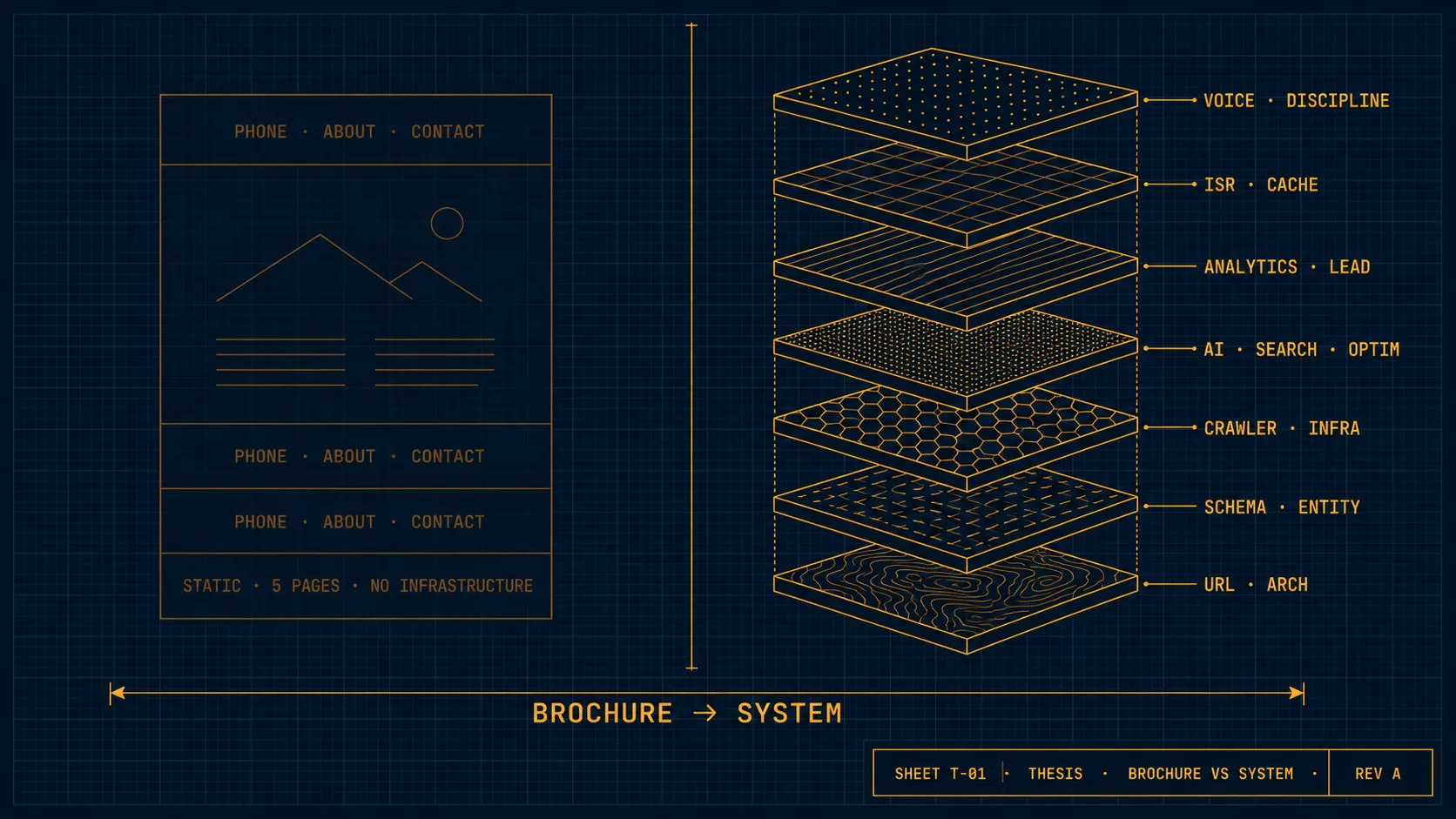
Most roofers' websites are a brochure. Yours will be a system.
The brochure approach is what every roofing contractor has tried for the last fifteen years. A web designer builds a five-page site, the contractor pays a monthly maintenance fee, traffic underperforms, and three years later it gets rebuilt. The website is treated as a finished thing instead of an operating system.
Peak Growth Roofing treats the website as the home base of a four-pillar marketing operation. Reputation (your Google reviews and BBB standing) is the entry door — if a homeowner doesn't trust you on the review surface, none of the other dollars matter. Reach (your website plus everything that drives traffic to it — SEO, GBP, social, video, paid ads) is what gets you in front of the buyer in the first place. Resell (email lists, maintenance plans, post-job follow-up) makes the second sale, which is roughly five times cheaper than the first. Referral (engineered, not accidental) turns happy customers into a sales force.
Most roofers focus on one of these. The ones who do all four win. The website is roughly thirty percent of the marketing system; the other seventy percent are workflows that happen outside the website but feed back to it. The Complete Stack covers all four pillars: Peak Growth Web as the website foundation, PGMD for the agentic media + AI-discovery layer, and the Peak Growth Playbook for the local-SEO, dashboard, and ownership layer — three components that lock together through a shared brand voice, a shared FAQ library, a shared analytics loop, and a shared image archive.
Built the way you'd build a roof.
Three products. One marketing system. Peak Growth Roofing · Slogan inventory
Most agencies rent you a storefront. We hand you the building.
Most marketing agencies build inside their own proprietary systems. The contractor keeps the domain — sometimes — but rarely owns the code, the website, the landing pages, the automations, the data, the reports, the workflows, the content archive, or the credentials behind any of it. When the relationship ends, the marketing operation ends with it, and the contractor starts from zero with the next agency.
Peak Growth is structured the opposite way. Every component lives under accounts in your name, on infrastructure you can transfer to any competent developer, with a written runbook documenting how it all fits together. The work we do compounds inside your business, not ours.
| Asset | Traditional agency model | Peak Growth owned model |
|---|---|---|
| Website | Built on the agency's CMS or proprietary platform; you license it month-to-month. | Your repository. Your code. Portable to any host or developer. |
| Codebase | Closed. You see the rendered pages, never the source. | Open. Hosted on your GitHub. Standard Next.js — every web developer in the country can read it. |
| Hosting / deployment | Bundled into the retainer; you don't have a login. | Vercel under your account. You hold the credentials. |
| Database | Often invisible — leads sit in the agency's CRM, your only access is a weekly export. | Supabase under your account. Direct read access to every row. |
| Google Business Profile | Agency claims it under their email; you're added as manager. | You own it. We're added as manager — removable in one click. |
| Search Console / GA4 | Agency property. You see screenshots in monthly PDFs. | Your Google account. Live data, exportable any time. |
| Social accounts | Mixed — sometimes the agency owns the page outright. | Your Business Portfolio. We're authorized admin. |
| Automations & agents | Agency-hosted, agency-licensed, often opaque. | Run on your VPS. Open-source runtime (Paperclip + Hermes). Configs are plain text on your server. |
| Content archive | Locked inside the agency's tools. Past posts and assets disappear with the relationship. | Plain Markdown on your VPS, mirrored to your Backblaze backup nightly. |
| Reporting | Monthly PDF. Numbers without source data. | Live dashboard you log into directly. Underlying queries documented. |
| Credentials map | Held by the agency. You don't know what exists or where it lives. | Single source-of-truth document — every account, every key, every owner — handed to you on day one. |
| Developer portability | Almost none. Migration means a full rebuild. | Standard stack. Any roofing-agency-trained developer can take over in days. |
| If the relationship ends | You start over. Marketing momentum resets. | You keep the website, the data, the social accounts, the agents, the dashboard, the runbook, and 30 days of on-call handoff support. |
Most agencies hand you a domain and call that ownership. We hand you the machine, the keys, and the dashboard to watch it run. That's not a marketing claim — it's a contract clause and a credential transfer that happens on day one.
Ask any contractor who has switched agencies mid-operation: if the relationship ends, does the business lose the dashboard, site portability, analytics continuity, and content archive? Does the next vendor have to rebuild from scratch instead of continuing where the last one left off? Does the owner even know where every credential lives — or does that knowledge walk out the door with the agency? The reset risk is real. A full rebuild typically costs more than the original build, takes six to twelve months to recover SEO momentum, and resets any authority or review velocity that had been accumulating. Owning the machine from day one eliminates that risk entirely.
You keep the keys. You own the machine. You can see it running. Owned authority · core posture
Three things changed in twenty-four months. Most local-services agencies haven't caught up.
AI search matters because homeowners are starting to ask engines for recommendations directly. If the brand is not visible, trustworthy, and structurally eligible to be cited, the company misses discovery before the click ever happens. The shift below is not a future prediction — it is happening on active searches today, and most contractor sites are not built to participate in it.
AI search is real. Google's AI Overviews appear on 15–48% of searches (BrightEdge, industry-weighted). ChatGPT crossed 900 million weekly users in February 2026 — up 4.5× from 200M eighteen months earlier. Perplexity, Claude, and Bing Copilot are pulling real query volume from the ten blue links. Sites without AI-search infrastructure — llms.txt, an AI-bot allow-list in robots.txt, server-rendered structured data, a connected entity graph — are getting locked out. Most contractor sites have none of this wired up.
Core Web Vitals are scored, not just measured. Slow sites lose rankings even with perfect content. LCP under 2.5s. CLS under 0.1. INP under 200ms. TTFB under 600ms. These are the targets the website ships against — measured every release.
E-E-A-T is being enforced. Author attribution, real credentials, license numbers, verifiable expertise — ranking signals now. The stack ships author records (Person schema)[13], explicit business credentials (LocalBusiness with license numbers, service areas, and hours), and reviews wired to a real Google Business Profile feed — not mocked.
Cited across ChatGPT, Perplexity, and AI Overviews
Peak Growth Web ships llms.txt, a full AI-bot allow-list in robots.txt, the Content-Signal directive, and an entity-graph schema purpose-built for AI citation. PGMD's Analytics Specialist runs a monthly citation probe — 5 queries per engine — so you see whether it's working, not just assume it is.
Fast by architecture, not by patch
Built on Next.js 16 with Static Site Generation and Incremental Static Regeneration. Targets shipped on every release: LCP < 2.5s, CLS < 0.1, INP < 200ms, TTFB < 600ms. Slow sites lose rankings even when the content is perfect.
Credentials Google and AI engines can verify
The Person schema component captures author credentials, license numbers, and service areas. Reviews pull from your real Google Business Profile — not mocked. Author bios link to verifiable LinkedIn profiles. Verified expertise is a ranking signal now.
The deadline isn't hypothetical. According to MIT Technology Review, the rise of AI assistants and AI search is shifting user attention away from traditional websites, as AI "answer engines" deliver responses directly instead of passing clicks on to publishers.[22] Julia McCoy, who tracks this shift across industries, puts a hard date on it: "By 2027, if your brand isn't showing up inside AI conversations, you might as well not exist."[21] Eighteen months from now is the window.
And the macro consequence. Adam Bensman, founder of the Roofing & Solar Reform Alliance, summarizes 36 months of conversations with manufacturers, PE CEOs, and M&A firms with a single forecast: "I predict that over the next 36 months we could see as much as 30% of roofing companies close their doors."[4] The contractors thriving are the ones adapting first and adapting deeply — to AI search, to owned discovery channels, to operations that absorb headcount instead of adding it.
This isn't only a roofing call. Ethan Smith of Graphite.io — who has worked in search since 2007 — ranks the shift to AI-search as the second biggest disruption in eighteen years, behind only Google's Panda algorithm that ended spam-based SEO in the early 2000s.[20] The fundamentals of search still apply; what changes is the surface where answers get delivered. Roofers who think this is hype are reading it wrong.
range by industry + measurement method
February 2026 — 4.5× the August 2024 figure
a channel that didn't exist three years ago

Ad spend alone won't save you. PE-funded competitors are explicitly trying to outbid local independents on Google and Meta. Bensman, quoting M&A-firm conversations: "One of the strategies outwardly expressed by Private Equity is to 'outbid' the competition — driving up costs to unbeatable levels. Expect less leads from your current ad budget."[4] The term "Roofing" is now one of the most expensive keywords in all of PPC and LSA — residential roofing leads run $150–$250 each on Google Ads, commercial leads $300–$500; brand saturation can pull that figure to $70 for contractors who have done the local-presence work first.[26] The contractors winning are the ones with owned discovery channels — SEO, AEO, AIO, organic social — that compound regardless of any ad-budget arms race.
The "Pac Man" consolidation has already started: JobNimbus took a $330M growth investment from Sumeru Equity Partners in November 2024[6], Verisk announced a $2.35B acquisition of AccuLynx in July 2025 — and then terminated it that December under FTC scrutiny over the combined entity's hold on Xactimate pricing data plus contractor financials[7]. The consolidation pressure is real even when individual deals fail. ServiceTitan continues to push into roofing in parallel[4]. Independent contractors who don't sharpen their marketing operation will be acquired — or eclipsed.
While the discovery channels shifted, three perennial truths about roofing leads held steady.
industry studies, US home services
response-time as conversion driver
Bensman 2025 — the era of the 2-hour in-home estimate appointment is closing
This is why the stack ships a 5-minute SLA on real leads[5], a structural Engagement Specialist agent monitoring comments and DMs across Facebook and Instagram, and a phone_click event wired into GA4. All the investment in AI-search visibility pays off only when the lead that does arrive gets a fast response — so we wire that into the system on setup rather than leaving it to memory.
85% of callers who reach voicemail will not call back. At a $9,000 average job and a 35% close rate, each missed call represents roughly $3,150 in revenue potential. Calling a lead within five minutes makes a contractor 100 times more likely to reach them than calling after thirty minutes. The 5-minute SLA, the Engagement Specialist, and the AI voice recommendation in this stack all exist because speed-to-response is the biggest conversion lever in home services — and the one piece of the funnel a system can take off a salesperson's plate.[26]
Three products. One operation. Zero redundancy.
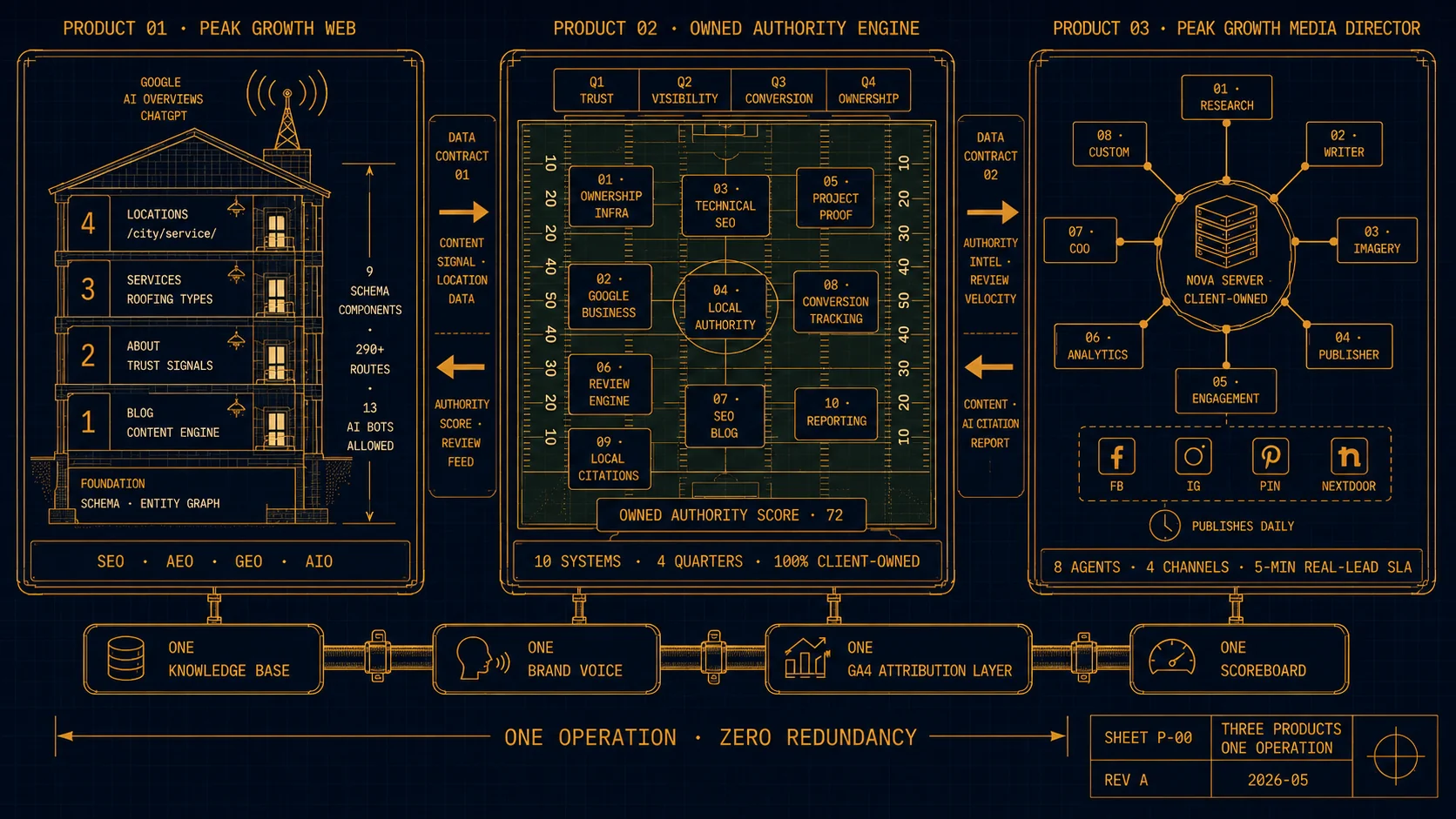
This is not the typical agency bundle — a website, some SEO, and a social package that each run independently and never talk to each other. The three products below are engineered as one operation: a Peak Growth Web power pack that serves as the command center; an Peak Growth Playbook that makes it locally visible, credible, and trackable; and a Peak Growth Media Director that keeps it in front of the right homeowners every single day. Each product has a distinct job. Together they close the gap between where your business is today and where it needs to be.
Peak Growth Web
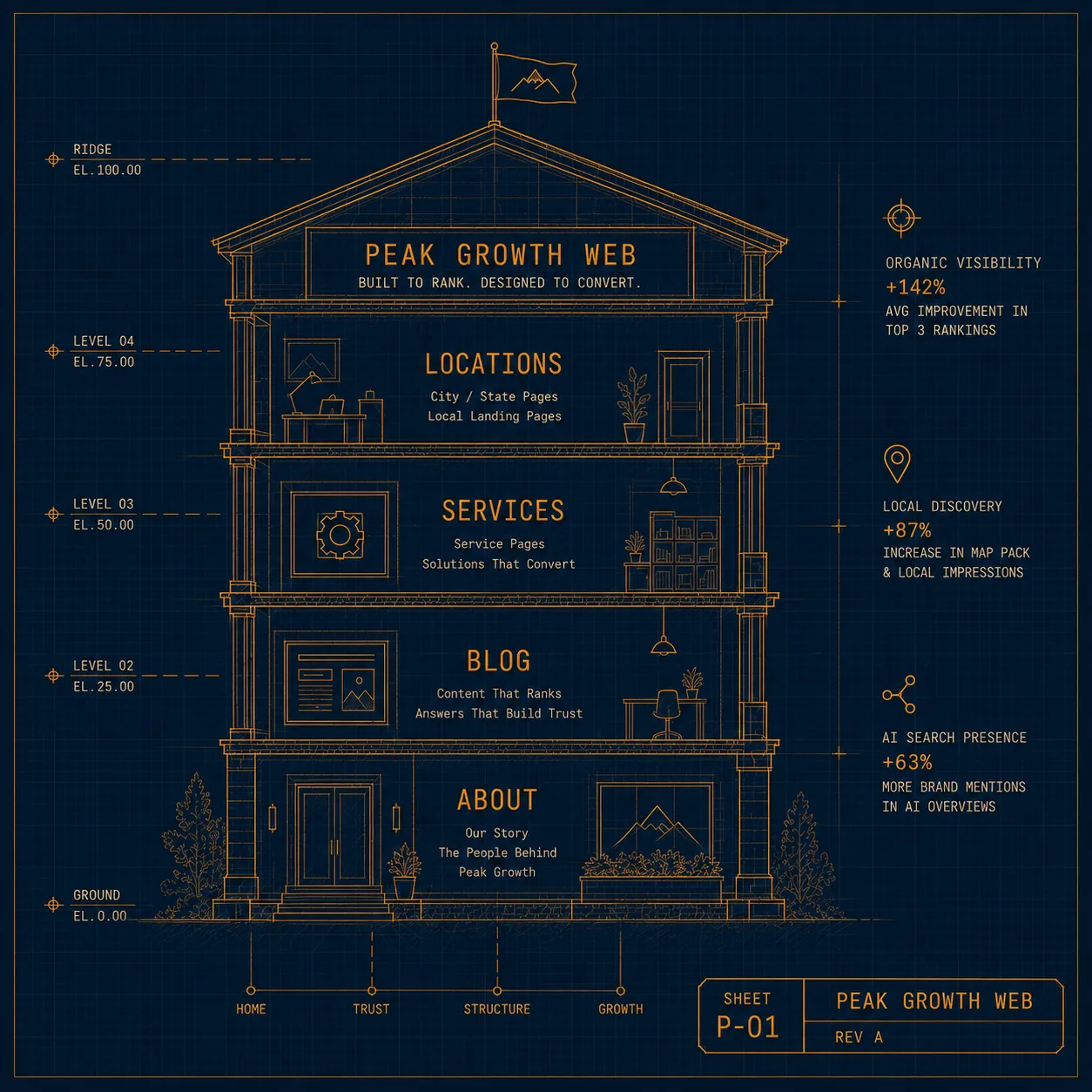
A sophisticated, beautifully designed front end built to attract homeowners, convert browsers into leads, and deliver instant quotes and estimates on demand. The back end is the real differentiator: a fully configured SEO, AEO, and AI-driven GEO architecture that makes the site findable across every surface a homeowner consults — Google, Maps, AI chat assistants, and voice. This is the command center everything else is built on.

Peak Growth Playbook
Ten systems built around the website to make it rank, get reviewed, get tracked, and stay yours. Google Business Profile foundation, technical SEO buildout, local authority architecture, project-proof system, review workflow, conversion tracking, citations, and a live Gamified Dashboard with the Scoreboard front and center — plus a monthly recap PDF with a local-competitor scout report.
Peak Growth Media Director
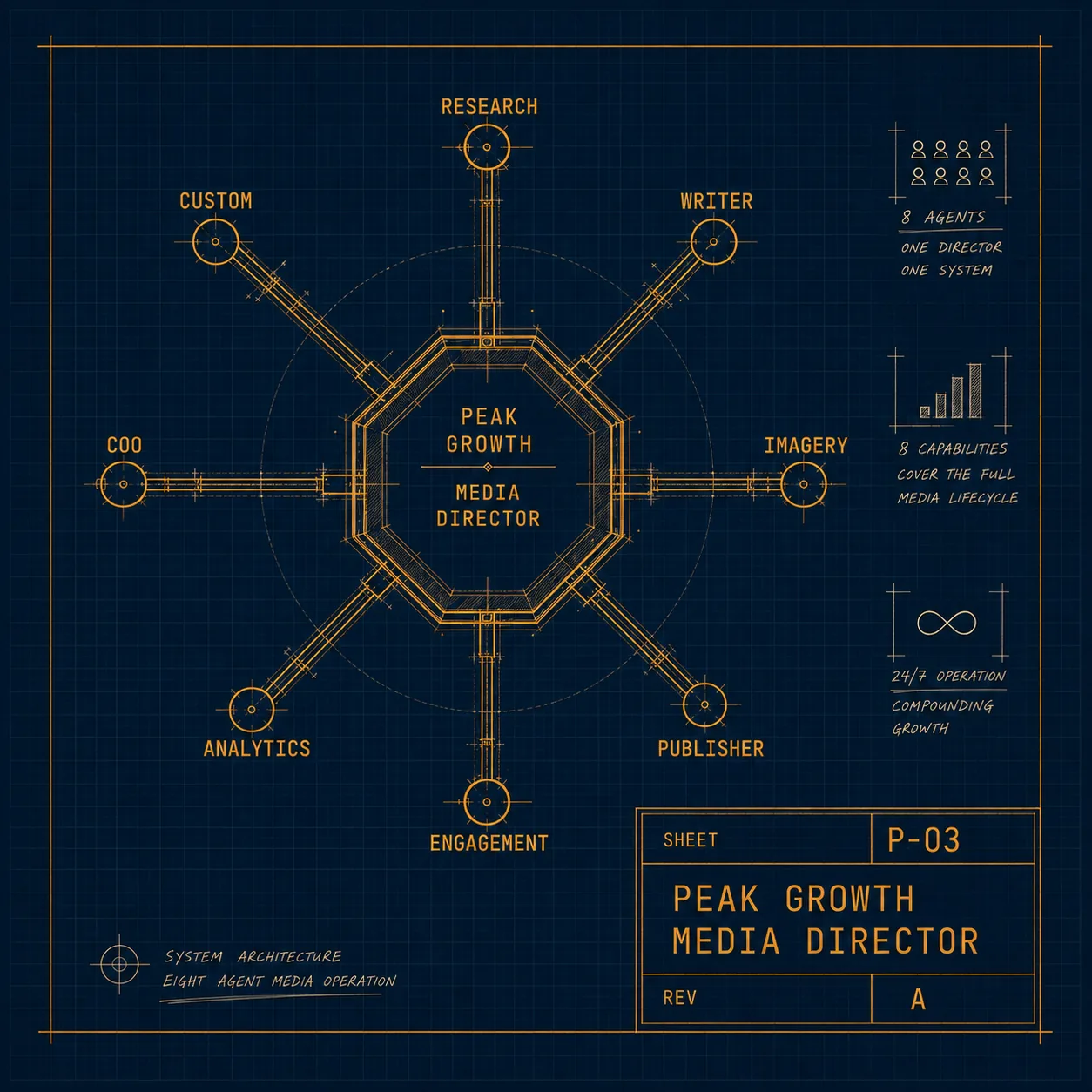
Eight specialist agents on your server. Publishes every weekday across Facebook, Instagram, Pinterest, Nextdoor. Always-on paid social. Telegram-based Custom Content Agent. Monthly AI-citation probes against ChatGPT, Perplexity, Claude, Bing Copilot, and Google AI Overviews — finds the gaps, feeds them back to the content engine.
The website is the authority hub. The Peak Growth Playbook wires it for local visibility — making it rankable, reviewable, trackable, and attribution-ready. The Peak Growth Media Director keeps it alive — continuous social publishing, paid social amplification, and AI-citation probes that close the discovery loop. All three share one Obsidian knowledge base, one brand voice, one FAQ library, one job-photo archive, and one GA4 attribution layer. No duplication. No gaps.
What we plug into your operation so the whole thing runs on autopilot.
Two halves below. Inputs 02, 03, and 05 are the marketing engine itself — the photo pipeline, the authority layer, the monthly review. We run these as part of the engagement. Inputs 01 and 04 are optional sales-team integrations — the 5-minute speed-to-lead scoreboard and the CRM-to-dashboard wiring. They're interesting capabilities your team can opt into when you're ready; the marketing engine still delivers if you'd rather keep the sales floor separate. Either way, the further you let us wire in, the less anyone has to remember to do anything manually.
Marketing that stops at the form fill is only half the system — if you want the other half.
This whole section describes an optional sales-team integration. The marketing engine (Sections 06–10) runs and delivers leads, dashboard visibility, AI-citation visibility, and review velocity on its own. If you want the marketing operation to share one language with your sales floor — same lead stages, same scoreboard, same monthly review — here's how that would work. Offered as a capability, not a requirement of working together.
One shared vocabulary for the whole operation
Lead stages are defined clearly and tracked consistently across marketing and sales so attribution is unambiguous:
Context before the first conversation
When a lead comes in, the system surfaces the context a rep needs to open strong and follow up effectively:
- →Where the lead came from — organic search, paid ad, GBP listing, referral, or social
- →What pages the homeowner viewed and what offers or trust signals they engaged with
- →What their likely objections are based on inquiry type and service area
- →Call and appointment tracking so no lead falls through the gap between marketing and sales
Each month, marketing quality and sales follow-through are reviewed against the same dashboard. Missed revenue is not blamed blindly on either side. Lost jobs feed back into content strategy, FAQ updates, and ad targeting for the following month.
This is a closed-loop operating system, not isolated marketing channels. Every lost job is a signal. Every closed job is a source of reviews, referrals, and content for the next cycle.
SEO, AEO, GEO, AIO — in plain English.
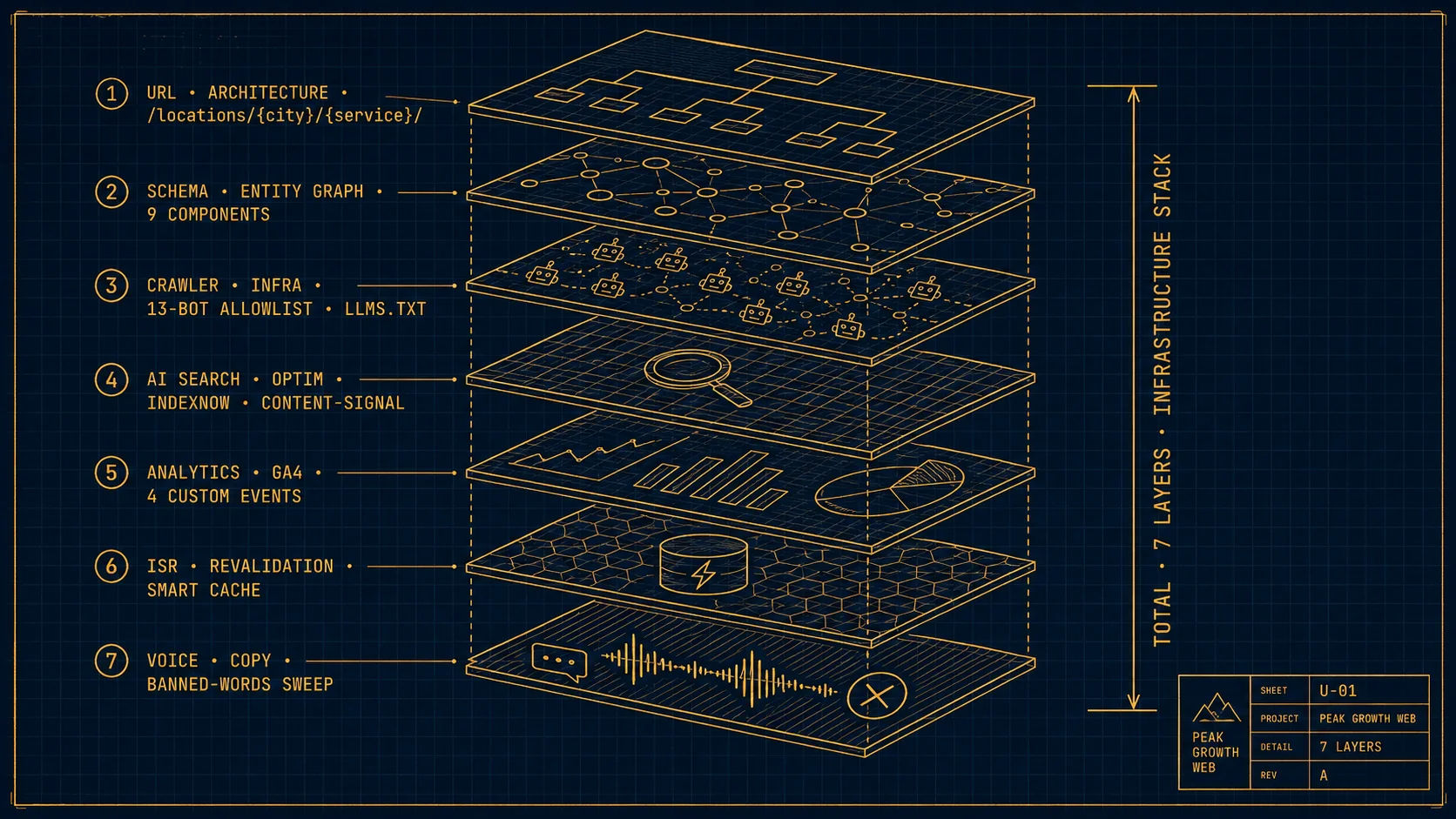
The website kit ships with the bones in place. The seven layers below are the structural infrastructure — the layers that make the site readable, structured, and eligible to be cited by every engine the homeowner consults. This is the website foundation. The Peak Growth Playbook (next section) is what runs on top.
Website layer (lives here, in Peak Growth Web): schema, service/city URL structure, metadata, llms.txt, AI-bot allowlist, structured content, crawlability, FAQ surfaces, the entity graph. The eligibility signals an AI engine looks for before deciding whether you can be cited at all.
Operations layer (lives in PGMD, ongoing): monthly AI-citation probes against ChatGPT, Perplexity, Claude, Bing Copilot, and Google AI Overviews. Finds where you're cited, where competitors are cited, where nobody is cited — and turns those gaps into content opportunities. The two halves work as one system; neither is double-charged.
The days of SEO only are numbered. People are turning to LLMs like ChatGPT to research companies and get recommendations. The new era of AEO is opening up quickly — and the game is very different from the old ways of doing SEO. Adam Bensman · Roofing & Solar Reform Alliance · 2025[4]
The new game is selection, not ranking. AI engines don't sort blue links — they pick. A billion-dollar brand can be skipped if its eligibility signals are weak; a small site can be recommended if its eligibility signals are strong.[25] Ranking number one on Google no longer guarantees anyone sees you. The kit's seven layers below are designed for one job: make the website eligible to be chosen by every engine the homeowner consults.
Four acronyms you'll hear from us. They map to four real things.
- SEO — Search Engine Optimization. Google's regular blue-link results, plus Bing and DuckDuckGo. Roughly 30% of the work is on-page (titles, structure, schema, page speed); roughly 70% is link-building and citations.
- AEO — Answer Engine Optimization. The feature box at the top of Google ("People Also Ask"), Google's AI Overviews, voice assistants. Different rules from regular SEO — you're optimizing to be the answer, not the link.
- GEO — Generative Engine Optimization. Citations inside ChatGPT, Perplexity, Claude, Gemini answers. New as of 2024; the rules are still being written.
- AIO — AI Optimization. Crawler directives — making sure AI bots (GPTBot, ClaudeBot, PerplexityBot, Google-Extended, Applebot-Extended) can actually read the site. Without this, none of the AEO/GEO work matters because the bots can't see the content.
Winning on those four surfaces takes depth, not novelty. Eric Siu of Single Grain puts it bluntly: "if you're not first in an AI answer, you're essentially invisible. Being cited once isn't enough — you need repeated presence across multiple citation sources."[23] The kit treats citation-building as an ongoing engine: listicles, FAQ surfaces, BOFU-intent pages, proprietary local data the homeowner can't get elsewhere, and presence on the forums AI engines actually pull from — Reddit chief among them. One citation is noise; eight citations across eight surfaces is selection.
The Peak Growth Web kit ships seven layers of infrastructure. They get implemented in order — layer 1 is foundation; if URLs are wrong, everything downstream is wasted work.
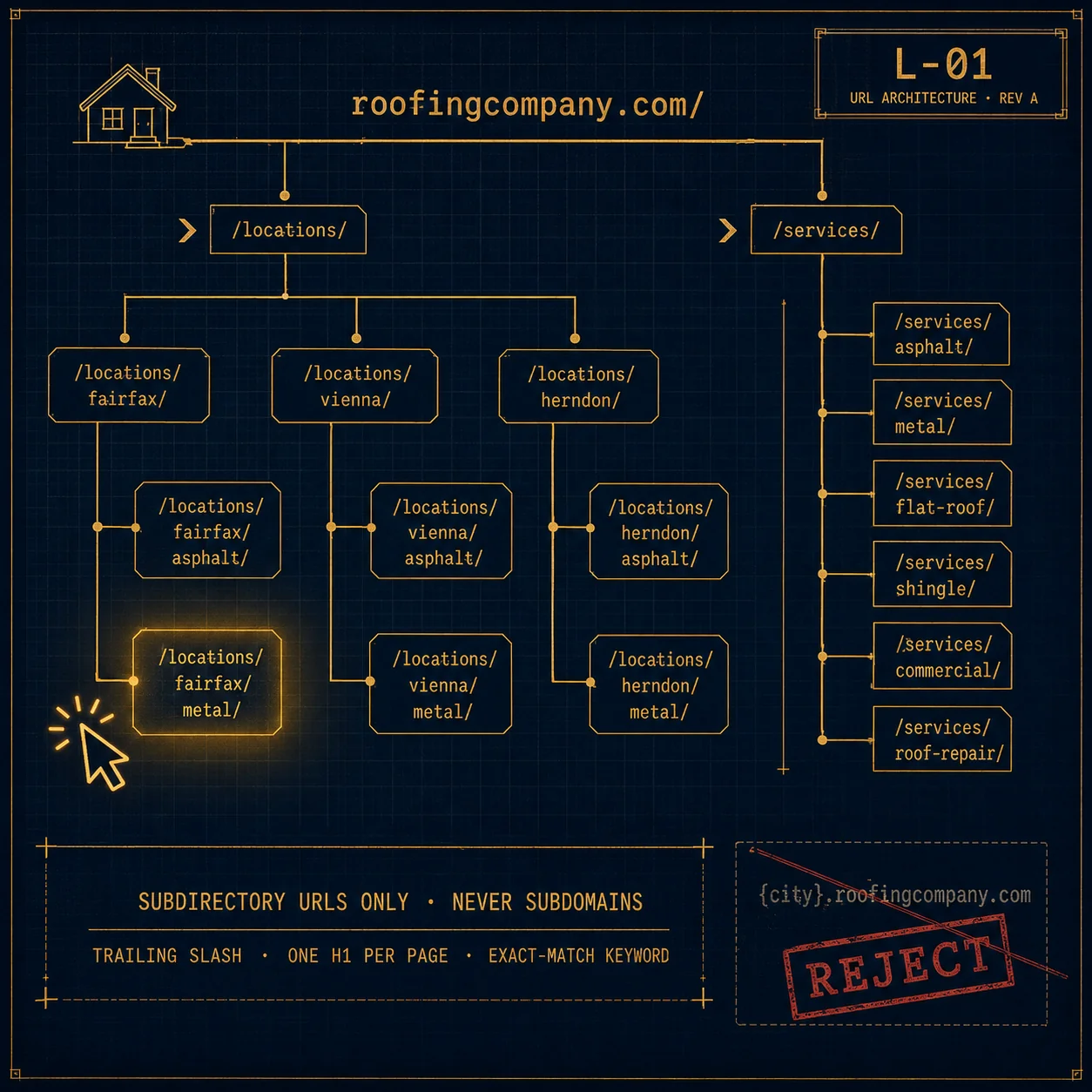
URL architecture that Google can rank
Subdirectory URLs only — never subdomains. /locations/{city}/ ranks under your main domain's authority; {city}.yourcompany.com would split it. Trailing slash everywhere, every page canonicalizes to itself, one H1 per page with the exact-match keyword. Service-by-city matrix at /locations/{city}/{service}/ so a homeowner searching "metal roof {city}" lands on a page targeted at exactly that query.
Structured data on every page
Server-rendered JSON-LD on every page — never client-injected. Nine schema components ship with the kit: Organization, LocalBusiness, RoofingContractor, Service, Material, Article, FAQPage, Breadcrumb, Person. Every node has a stable identifier; every node points back to the parent Organization. Google reads the business as a coherent multi-location service entity instead of a pile of disconnected pages.
13-bot allow-list + Content-Signal directive
robots.txt with explicit allow entries for thirteen AI bots — GPTBot, ClaudeBot, PerplexityBot, Google-Extended, Bytespider, CCBot, Meta-ExternalAgent, cohere-ai, Applebot-Extended, and others. Plus the Content-Signal: ai-train=yes, search=yes, ai-input=yes directive that tells AI engines they have permission to use the content. Native app/sitemap.ts generating every public route in priority-tiered XML. Separate image sitemap so jobsite photos surface in Google Images.

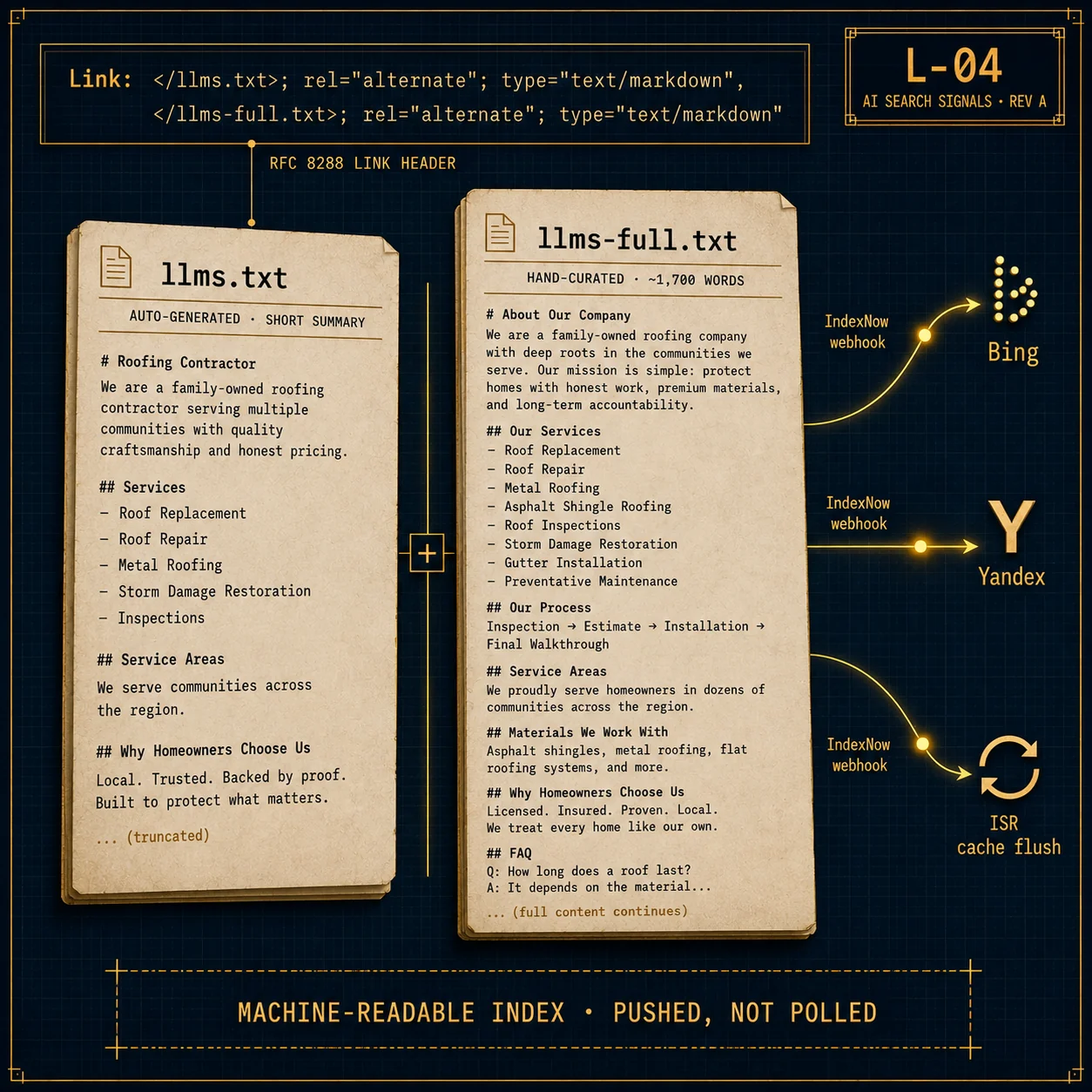
llms.txt + IndexNow + Link headers
llms.txt (auto-generated short summary) and llms-full.txt (hand-curated long reference, around 1,700 words). Together these give AI engines a clean, structured version of the site to cite from. RFC 8288 Link headers advertise both files as text/markdown alternates from every page response. IndexNow webhook pings Bing and Yandex on every content change; Internal Server Render webhook flushes the Next.js cache simultaneously.
Four custom events tied to business outcomes
Google Analytics 4, environment-gated (zero scripts in development), respecting Do Not Track on the browser. Four custom conversion events shipped: phone_click (every call CTA, tagged by location), generate_lead (form submissions and estimator completions), estimator_submit (multi-step funnel), service_area_hub_click (city-card navigation). Every event tagged with city and service so you can see which markets drive which leads. These events feed Google Ads conversions, Meta Conversions API, and any CRM you wire in.

Smart caching, manual flush
Layout-level baseline of 24-hour cache; per-page overrides (homepage hourly, blog weekly). No force-dynamic on marketing pages — that defeats static generation. Manual cache flush via the revalidation API route when content edits land.

Banned-words sweep on every commit
A banned-words list runs on every content commit — about fifty words covering hype superlatives ("premier," "world-class," "industry-leading") and AI-writing tells ("delve," "navigating," "comprehensive," "essential to"). Customer-problem-opener pattern: lead with what the homeowner is dealing with, not what you do. Reading-level target of 5th–6th grade. Concrete numbers and local landmarks instead of abstractions.

Six steps the kit executes — quietly, monthly.
The seven layers above are infrastructure. The ongoing AEO work that runs on top of them follows Julia McCoy's framework, condensed into how the kit operates against it.[21]
- Long-tail conversational keywords. Match how homeowners actually ask AI engines a question, not the keyword tools' shortest form.
- Low-competition AEO keywords. The keywords competitors haven't realized matter yet — the kit's content briefs target these first.
- Informational intent first. Answer the question; the conversion follows. Pages built around "how much does a metal roof cost in {city}" outperform pages built around "metal roofing services."
- Multi-feature visibility. One page, four surfaces — featured snippets, People Also Ask, AI Overviews, and the blue-link results.
- Brand authority across the web. Citations from trade publications, review platforms, Google Business Profile, Reddit threads, and AI training corpora. Depth matters; one citation is invisible.
- Systematic gap analysis. Monthly AEO probe runs against your service area's top homeowner questions in every engine — what cited you, what cited a competitor, what cited nobody — feeding next month's content brief.
One legitimate brand, one clean domain, a Google Business Profile that's actually alive.
We are not just building a website. We are building a local authority system for roofing in Northern Virginia. The strategy is one legitimate brand everywhere, one clean search-friendly domain, a living Google Business Profile, service and city pages that capture local demand, real project proof, structured data, and AI-readable authority signals — all pulling in the same direction.
The naming layer balances trust, local search, and long-term brand ownership. NOVAroofing.com gives the company a strong search-friendly front door. Restoration Roofing of Northern VA gives the company a credible, regional brand identity. We recommend using one legitimate business name everywhere — on the Google Business Profile, in citations, in the site footer, in schema, on social — then letting the SEO structure do the keyword targeting underneath through service pages, city pages, Google Business services, reviews, photos, FAQs, schema, and content.
This protects the Google Business Profile from looking manipulated while still letting the company rank for the searches that matter: Northern Virginia roofing, roof repair, roof replacement, storm damage, insurance roofing, emergency roof repair, and city-specific roofing terms. The result is a brand that looks real to homeowners, clean to Google, and highly legible to AI search engines.
| Layer | Recommendation |
|---|---|
| Brand name | Restoration Roofing of Northern VA — used consistently everywhere (GBP, schema, citations, footer, social). |
| Primary domain | NOVAroofing.com — search-friendly, memorable, regional by name. |
| Secondary domain | RRNOVA.com — 301-redirected to NOVAroofing.com (defensive, not a second site). |
| Google Business Profile name | Restoration Roofing of Northern VA — matching the public-facing brand. |
How the system connects
- Google Business Profile is the living storefront. Maps visibility, photos, posts, Q&A, and reviews — the surface most homeowners actually click first on a phone.
- The website is the authority hub. Service pages, city pages, project proof, and FAQs live in a structure Google and AI engines can read.
- Reviews are the trust signal that compounds everywhere. They lift the GBP, lift the city pages they're embedded on, and feed the AI engines deciding which contractor to cite.
- Service pages and city pages capture local demand. One page per service, one page per city — each linking to the GBP, to relevant project proof, and to schema that names the business, the service, and the area.
- Social, video, and AI-search probes close the loop. Active distribution feeds the brand signal; monthly probes reveal where ChatGPT, Perplexity, Claude, and Google AI Overviews are citing competitors but not you — every gap becomes next month's content.
The full asset map
| Asset | Role |
|---|---|
| Brand name | Builds trust and consistency across every surface a homeowner or engine touches. |
| NOVAroofing.com | Search-friendly front door — easy to remember, easy to type, regional by name. |
| Google Business Profile | Local Maps visibility and primary mobile conversion surface. |
| Reviews | Trust, local-ranking signal, and AI-search credibility input. |
| Service + city pages | Capture local search demand at the keyword level. |
| Project proof | Real-world evidence for homeowners, Google, and AI engines. |
| Schema | Machine-readable clarity — LocalBusiness, Service, FAQPage, Review, Person. |
| Social + video | Brand activity, ongoing proof, and distribution beyond search. |
| Dashboard | Tracks what is working — and where to push next. |
The name gets the company in the room.
The authority system gets it recommended. Peak Growth Roofing · Local authority operating model
The website is the front door. The Engine makes it rank, get reviewed, get tracked, and stay yours.
Ten systems built on top of the website to turn it from a published site into a ranking, locally-visible, review-building, fully-instrumented, client-owned authority operation. Each system has a clear scope, a clear AI-vs-human division of labor, and a clear "why it matters to a roofing company."
We weave the 4R lens through these systems — every system primarily serves Reputation, Reach, Resell, or Referral. The pillars are how a roofer should think about marketing strategy; the systems are how that strategy actually gets delivered.

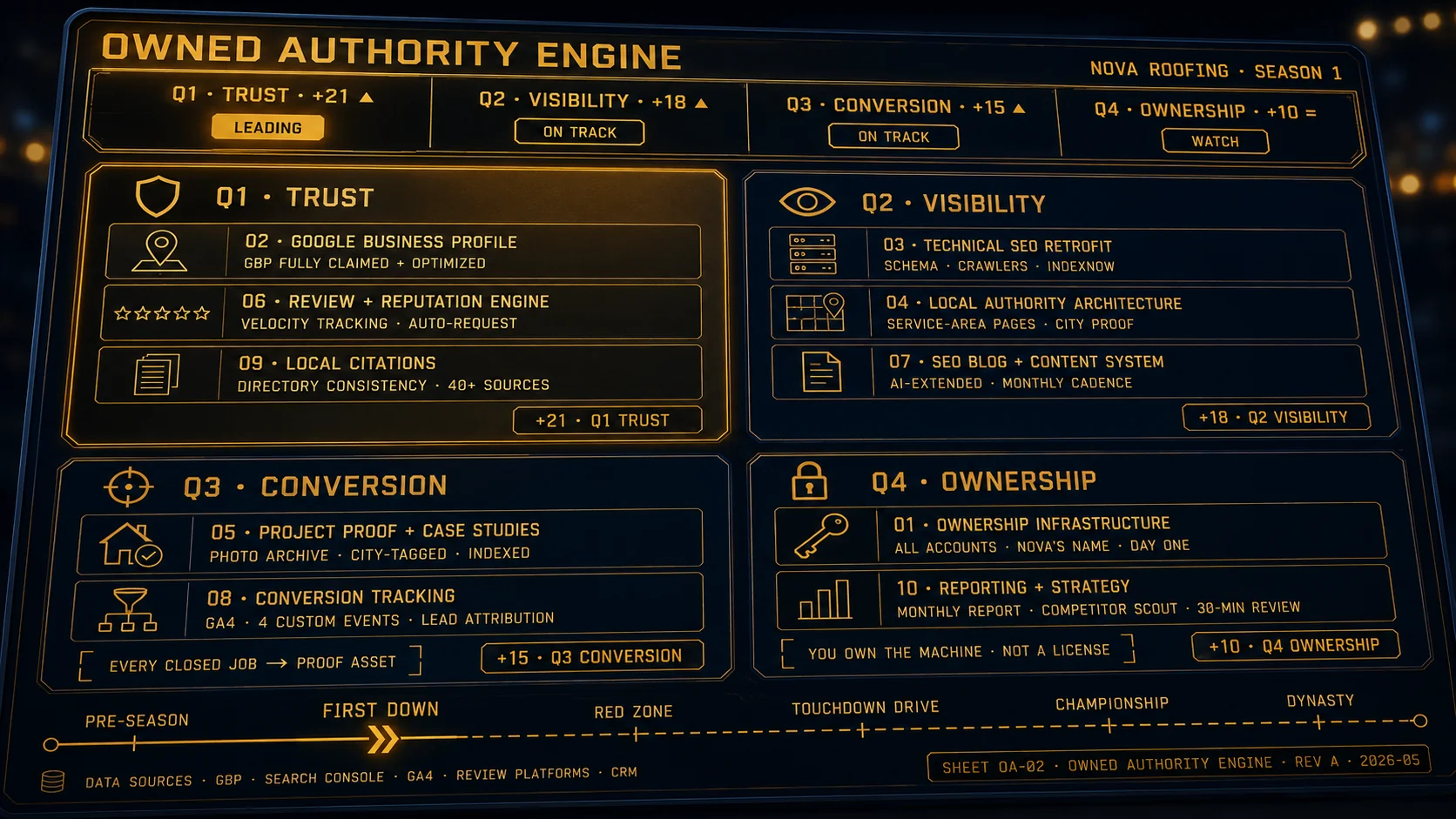
System 01 · Ownership Infrastructure · 4R lens: foundation
Single-source ownership map of every credential, account, and integration. Domain, GitHub repo, Vercel project, Supabase database, VPS, GBP, GA4, Search Console, social accounts, ad accounts, password vault, backup destination. Plus a written runbook covering every component, every schedule, every recovery procedure.
If we ever stop running your account, you have one document that tells any competent developer how to take over without missing a post or losing a lead. Most agencies cannot produce this; most contractors don't realize they need it until the relationship ends.
Drafting the runbook from observed system state. Generating credential-rotation reminders. Surfacing access drift (e.g., expired tokens, stale managers on GBP). SOP authoring as new components are added.
Every credential transfer. Every domain ownership verification. Every two-factor reset. Every legal/insurance-sensitive access boundary. AI cannot complete a Google Business verification or a Vercel ownership swap.
System 02 · Google Business & Maps Foundation · 4R lens: Reputation + Reach
Profile claim/verification. Categories and services. Service-area definition. Hours, phone, website with UTM-tagged link. Q&A seeded with the FAQ library. Photo upload cadence. Posts cadence. Review-request workflow wired to GBP. Insights tracking.
4 weekly GBP posts (offers, projects, news, FAQs). Photo refresh from active jobsites. Q&A monitoring. Service-area tweaks based on Maps performance. Insights review feeding the dashboard.
Drafting weekly GBP posts in your voice from job photos and the content backlog. Drafting Q&A answers from your FAQ library. Triaging which insights anomalies deserve human attention.
The verification call/postcard. Final approval on photo selection from sensitive sites (insurance jobs, named customers). Review responses where the customer named a problem or a person.
For local-services queries, the Map Pack is often the result a homeowner clicks. A neglected GBP forfeits that surface to whichever competitor put in the work. The single best hour of roofing marketing is GBP optimization done well, then maintained.
System 03 · Technical SEO · 4R lens: Reach
Sitemap audit and rebuild. robots.txt tightening (AI-bot allowlist + crawler directives). Metadata on every public page (title, description, OG, Twitter, canonical). Schema audit and additions where the kit's nine components don't yet cover an edge case (e.g., JobPosting, Event for storm-response campaigns). Internal-linking pass. Crawl/index hygiene against Search Console. Speed and mobile review against Core Web Vitals targets.
Search Console error sweep. Core Web Vitals trend check. Internal-linking pass for new pages. Schema validation against Google's Rich Results test. Sitemap regeneration if structure changed.
Metadata drafting at scale. Schema generation. Internal-linking suggestion based on topic graph. Crawl-error triage. Image alt-text generation. Page-speed regression flagging.
The judgment calls that affect rankings — what to canonicalize, what to no-index, when to consolidate thin pages. Anything touching live traffic on a producing service-area page.
System 04 · Website Local Authority Architecture · 4R lens: Reach
Service-area map matching the actual book-of-business. Priority city plan (which 5–10 cities matter most, where the next batch lives). Service-by-city page architecture (the website kit ships /locations/{city}/{service}/ — the Engine fills it with prioritized content). Location pages with real local proof (projects, neighborhoods, landmarks). Internal-link graph that lifts priority cities.
Two new or upgraded city pages per month, prioritized against where the leads are coming from (or where they should be coming from). Internal-link refresh as new pages publish.
City-page outlines from local-data inputs (zip codes, neighborhoods, building stock, common roof types). First drafts of city-page copy. Internal-link suggestions across the site.
Local market judgment — which neighborhoods actually matter, which landmarks resonate, which competitors deserve naming, which storms or insurance carriers shape the conversation. AI cannot tell you which city is worth a page.
System 05 · Project Proof & Case Study System · 4R lens: Resell + Reputation
Standard intake template for every job (address, scope, materials, before/after photos, customer permission for use, dollar-value range, insurance posture). Project page template (location-tagged, schema-typed). A workflow that captures the field data without adding 30 minutes to the crew's day.
1–2 new project case studies published. Each case study cross-linked to the relevant city page, service page, and FAQ entries. Photos cycled into the GBP and social rotation.
Drafting the case-study narrative from intake fields and photos. Suggesting the cross-links. Generating the meta description and OG image variants.
Real photos only — never AI-generated for completed work, structurally enforced. Customer permission. Naming, location-precision (street-level vs. neighborhood). Anything touching insurance claims or sensitive personal information.
System 06 · Review & Reputation Engine · 4R lens: Reputation
Three-touch review-ask workflow (email + SMS + a final ask at job close). Review-platform recommendation per market (NiceJob / GatherUp / Podium). Reply workflow with response templates and escalation rules for negative reviews. Reputation tracking dashboard tile. Quarterly competitor review-gap report.
New reviews from completed jobs. Reply to every review (positive in 24 hours, negative escalated to owner first). Reputation tracking against the 50+ reviews / 4.5+ stars target.
Drafting review replies. Drafting the review-ask sequences. Tracking review velocity. Detecting review-themed clusters (e.g., "10 customers mentioned the cleanup crew" → social content opportunity).
Negative reviews always. Anything where the customer named a person or a complaint of substance. Approving the review-ask copy. Picking which review-platform to standardize on.
Reputation is the entry door of the 4R framework. Without 50+ reviews at 4.5+ stars, every other dollar in this proposal underperforms. The review workflow is the single most important non-website system in the Peak Growth Playbook.
System 07 · SEO Blog & Content System · 4R lens: Reach + Resell
Content briefs for the durable, Google-searchable assets that make the website rank: cost guides, storm guides, FAQ hubs, project case studies, service-area pages, roofing education posts. Editorial cadence (target: 1 long-form per month + 2 shorter answers + 1 case study). Topic-cluster map.
1 cornerstone long-form (cost guide / storm guide / authority piece). 2 supporting answer pages. 1 project case study. Internal-linking refresh. AI-citation gap report from PGMD feeds next month's brief queue.
PGMD finds, drafts, and distributes content across social and AI-discovery channels. The SEO Blog & Content System turns that same intelligence into durable website authority: cost guides, service-area pages, project case studies, FAQ hubs, roofing education posts, storm guides, and Google-searchable content that compounds over time. PGMD identifies the topic, processes the photos, and monitors which AI engines cited it. The Peak Growth Playbook side turns those opportunities into the cornerstone web pages that rank in Google and feed every other channel.
Topic discovery from the AI-citation probes. Outline generation. First drafts of long-form pieces. FAQ generation from sales conversations. Internal-linking suggestions. Image alt and metadata.
Final editorial approval. Anything claiming local-market expertise (storm specifics, insurance carriers, named cities). Anything legal/insurance-sensitive. Project case studies always require customer sign-off.
System 08 · Conversion Tracking & Attribution · 4R lens: Reach (measurement layer)
GA4 review and event audit. Search Console connection. Phone-call tracking plan (call rail or equivalent). Form-submission tracking. Estimator-completion event. UTM convention across every campaign and link. Lead attribution summary that ties each booked inspection back to a source.
Source attribution report (which channel produced which booked inspection at what cost). UTM hygiene check. Event regression check. Insights surfaced to the dashboard.
Anomaly detection in event volumes. UTM-mismatch flagging. Drafting the attribution summary. Calculating cost-per-source from raw event and ad-spend data.
Knowing which leads actually closed (the CRM source field requires you and your sales team to maintain it). Judgment on attribution windows and credit assignment.
System 09 · Local Citations & Off-Site Authority · 4R lens: Reach
Citation campaign across 30+ directories with NAP (Name / Address / Phone) consistency sourced from OrganizationSchema.tsx. BBB profile. Industry-association profiles (NRCA, regional). Manufacturer-certified-installer pages where applicable. Directory-quality grading.
NAP consistency audit. New directory submissions when better targets surface. Removal of low-quality listings discovered. Citation-velocity tracking.
Directory discovery. NAP consistency checking at scale. Drafting business descriptions in the brand voice for each listing. Detecting outdated listings.
Backlink relationships — partnerships with local manufacturers, suppliers, trade associations. AI cannot make a phone call to a roofing supplier asking for a partner-page link.
System 10 · Reporting & Quarterly Strategy · 4R lens: cross-pillar measurement
Monthly written report (what published, what changed, what worked, what didn't, what's blocked, what's next). Quarterly strategy review (90-day forward roadmap, priority shifts, budget reallocation). Executive summary tile on the dashboard for the owner who wants the 15-second version.
Report drafted in the first week of the following month. 30-minute review call. Action items written to the dashboard's Needed-From-You queue.
Report drafting from observed system state. Anomaly summary. Trend visualization. Recommendation drafting based on tracked KPIs.
Final strategy. Budget shifts. Quarterly priority calls. Anything where the recommendation needs to weigh business factors (cash flow, crew capacity, family schedule) the system doesn't know.
Owned authority, not rented marketing. The website is the home base. The dashboard is the window. The runbook is the safety net. Peak Growth Playbook · operating posture
Eight specialist agents. One operating team.
Each agent has one job, the way a professional agency has a research department, a copywriter, a designer, a production manager, and an analytics person — plus an internal COO orchestrating the team and a Telegram-based agent that gives you direct control.
The infrastructure
A dedicated Hostinger KVM 8 VPS provisioned in your name — 8 CPU cores, 32 GB of RAM, 400 GB of fast storage. Roughly $12–25 per month, billed directly to your card. Think of it as a small digital office building rented under your business, where a team of AI specialists live and work on your growth operation. The control plane sits on Paperclip (an open-source MIT-licensed orchestration platform). The agents themselves run on Hermes (Nous Research's open-source agent runtime). Memory and knowledge are stored in Obsidian (the second-brain platform) — every post, every source, every decision, all plain Markdown files on your VPS, owned outright. If our relationship ever ends, you keep the entire system and run it without missing a post.
The eight agents

Research Specialist
Every morning, scans roofing trade news, manufacturer announcements, NOAA weather alerts, state insurance updates, homeowner discussions. Writes 20–30 topic opportunities to the knowledge base.

Writer
Pulls top opportunities and drafts 2–3 structural variants per post. Tagged for channel fit and risk level. Enforces brand voice. Never fabricates a statistic.

Imagery Specialist
Generates visuals using three roofing-tuned skills. Real portfolio work always uses real photos — that rule is structurally enforced. We do not fake completed work.

Publisher
Handles API calls to Meta, Pinterest, and ad platforms. Manages rate limits, retries, scheduling. Staggers posts across the day rather than firing them all at 9 AM.

Engagement Specialist
Monitors comments, DMs, tags, and mentions across Facebook and Instagram. Answers FAQ-level questions with required bot disclosure. Flags real leads for human response within 5 minutes.

Analytics Specialist
Daily engagement pull, weekly dashboard, monthly strategic report, quarterly review. Tracks review velocity. Runs monthly AI-citation tests against ChatGPT, Perplexity, Claude, Bing Copilot, and Google AI Overviews.[4]

COO
The senior internal agent. Reports to Agentic Personnel. Watches throughput, coordinates handoffs, holds the team to budget. You don't interact with the COO directly — that's the Agentic Personnel team's job.

Custom Content Agent
Your direct line. Telegram-only. Send a photo, describe what you want to say, and it drafts a post in your voice. Lets you edit. Publishes now or schedules. Pull-down request goes through in under ten seconds.
Bensman's Pro Tip: "Go search ChatGPT for 'Best Roofer in [your city].' Then 'What are people saying about [your roofing company]?' See how you rank and what AI knows about you."[4]
The Analytics Specialist runs that probe every month against five engines — ChatGPT, Perplexity, Claude, Bing Copilot, and Google AI Overviews — and writes the gaps directly to your content backlog.
Three roofing-specific imagery skills
Premium Roof Showcase
Hero-shot quality. Magazine-cover architectural shingles, twilight-lit metal, drone-height angles for steep pitches. Used for conceptual and brand content; never for specific completed jobs.
Roofing Image Generator
The workhorse. Knows roofs the way a crew knows roofs — plywood spacing, underlayment layup, ridge caps, valleys, eaves, flashing — and the way each looks during each phase of a job.
Roofing Branding Image Generator
Layers your visual identity on top of the Roofing Image Generator. Your color system, your mascot, your typography. Drop into a seasonal ad campaign without a reshoot.
Governance
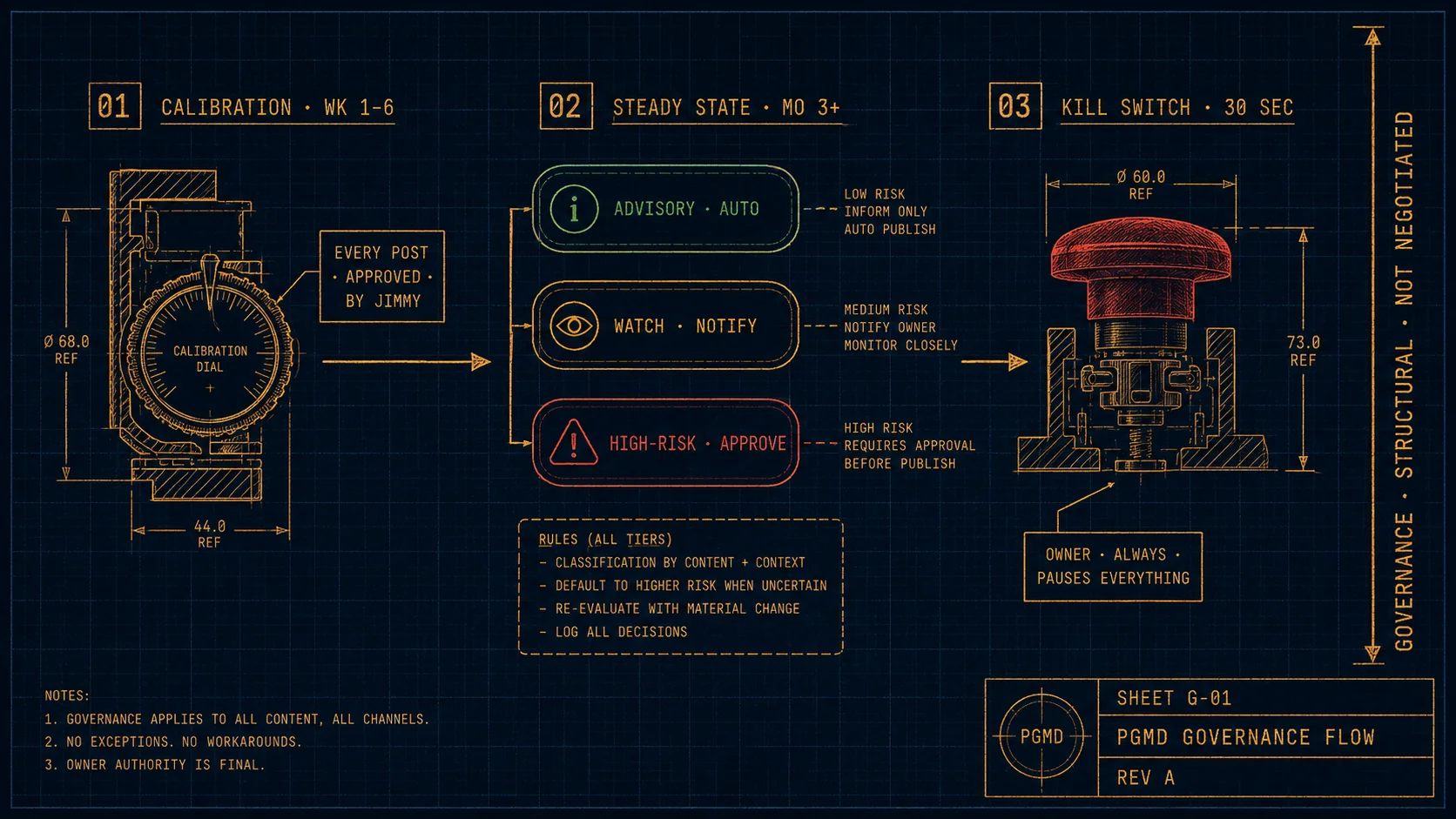
Approvals are not one of the eight agents — they're a structural governance layer enforced by the control plane itself. Build phase (weeks 1–8): the agent team is being configured, brand voice tuned, approval queue wired — no public publishing yet. Calibration phase (3 weeks following build): every post is manually reviewed by the Agentic Personnel team, not by you. Week 1 every post inspected; week 2 every other post; week 3 spot-checks only. Your job is to run your roofing business; our job is to dial in the system. Steady state (week 12 onward): low-risk content auto-publishes (logged, 24-hour reversibility); medium-risk content auto-publishes with a same-day notification to Agentic Personnel; high-risk content (insurance claims, named customers, legal topics) is the only tier requiring your explicit approval. The default experience is hands-off. From Telegram you can pause any channel, any campaign, or fire the master kill switch — pauses everything within 30 seconds.
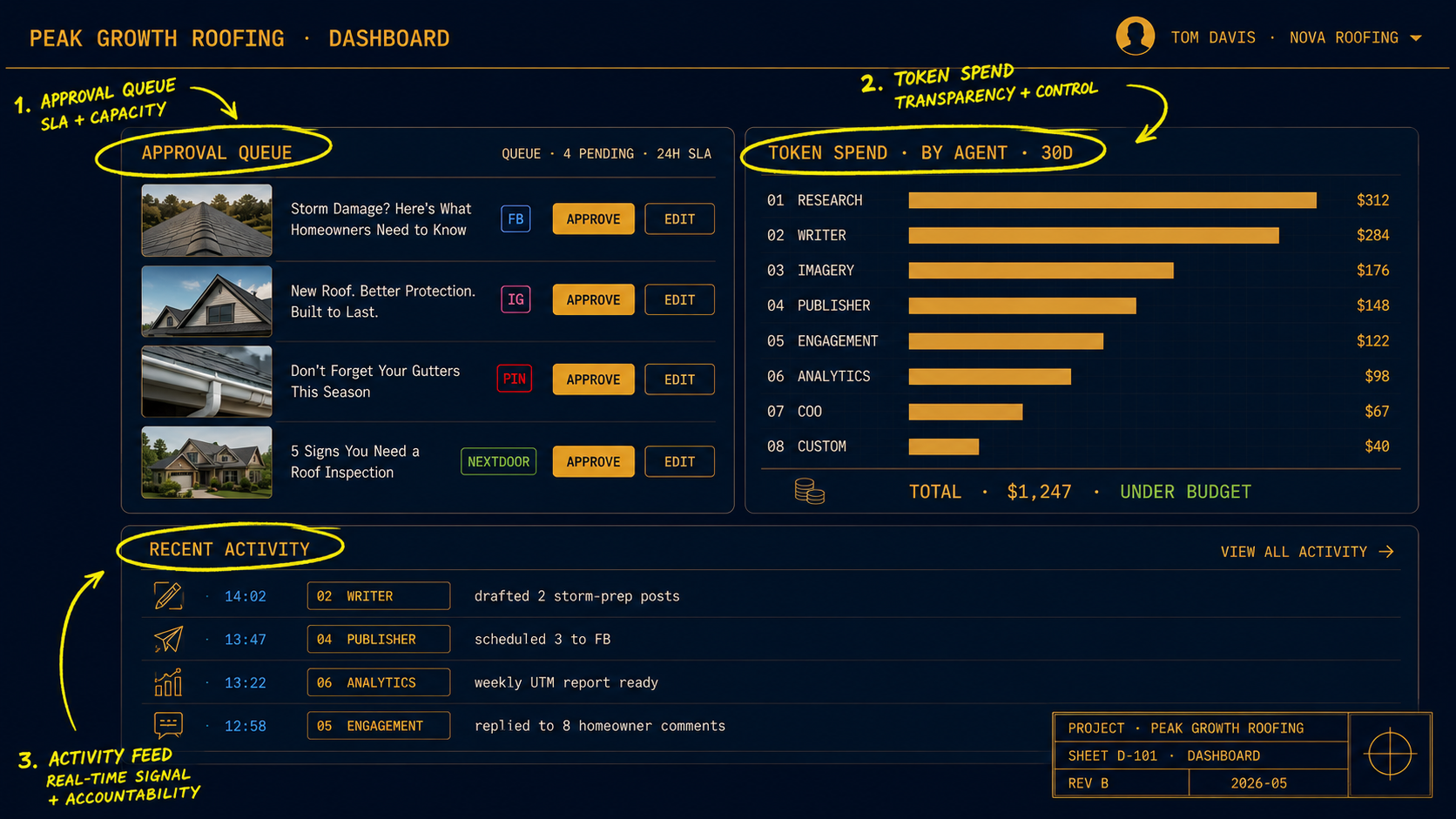
Your dashboard
Production-grade. Mobile-first. Magic-link auth tied to your business email. The full org chart of your eight agents and what each is doing right now. Active campaign performance across all four publishing channels. Monthly token spend per agent. Recent activity feed. Approval queue. Review-velocity tracker. AI-citation standing across ChatGPT / Perplexity / Google AI Overviews. An immutable audit log of every decision and every tool call.
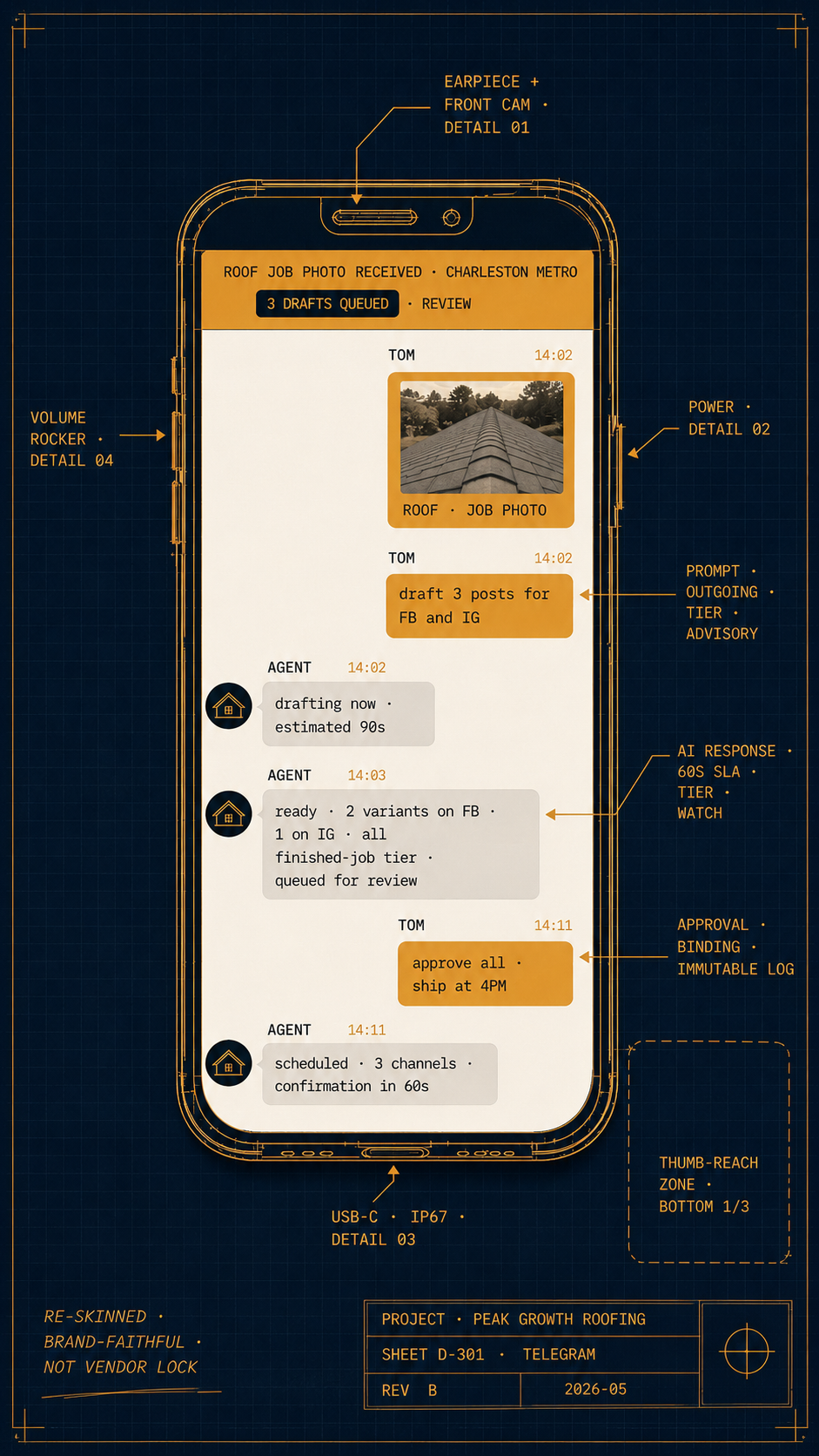
Telegram custom-content thread
The Custom Content Agent is your direct line. Send it a job photo from the phone in your pocket; it drafts a post in your voice, tagged for channel fit, queued for review or scheduled if you said publish-now. Pull-down works the same way: ask for a takedown, get confirmation in seconds.
The monthly technical sweep
Every month we audit the entire stack against the current state of the art. Newer Claude models. Cheaper inference routes. Paperclip and Hermes updates with integration tests. Skill-evolution review. New platform APIs. Anything that makes the system faster, cheaper, or more effective gets deployed.

The system calibrated in month four is not the system you'll have a year in. It will be measurably better. Monthly technical sweep · operating principle
The new battlefield for roofing will take place online, and those who master their marketing will dominate their market. Adam Bensman · 2025[4]
How the homeowner journey hits every layer of the stack.
A discovery → intake → convert → retain topology. Each card names the responsible product or system and its tooling. The arrows are implied — discovery flows through search, social proof, and referral channels; the Lead Marketer organizes everything into a single CRM record; the website is the conversion surface; the Peak Growth Playbook dashboard makes the whole journey visible; retain-and-refer is the post-job pillar that produces the next customer at one-fifth the cost.
Homeowner
Finds a roofer through search, reviews, ads, social proof, referral, or storm response.
- OWNER
- Decision maker
- TOOLS
- Google · social · website · phone
Google discovery
Google Business Profile, Map Pack, organic SEO, service-area pages, and Google Ads capture high-intent searches.
- OWNER
- Peak Growth Web
- TOOLS
- Schema · sitemap · llms.txt · IndexNow · GA4
Media and proof
Peak Growth Media Director turns reviews, job photos, homeowner questions, and local proof into social and content demand.
- OWNER
- PGMD
- TOOLS
- FB · IG · Pinterest · Nextdoor · Obsidian KB
Reviews, citations, GBP
Peak Growth Playbook — review engine, GBP posts, citation hygiene, project case studies, storm-response campaigns. The local-visibility surface.
- OWNER
- Peak Growth Playbook
- TOOLS
- GBP · NiceJob · BrightLocal · email · referral flow
Lead Marketer
Tracks source, campaign, service area, lead quality, cost per lead, and booked inspection rate.
- OWNER
- Marketing ops
- TOOLS
- Attribution · CRM source fields
Website entry
Homeowner lands on the website, chooses instant estimate, intake form, or phone call.
- OWNER
- Peak Growth Web
- TOOLS
- Forms · phone wrappers · GA4 · ISR
Intake + qualification
Address, contact info, roof concern, urgency, insurance status, service-area fit, source, and next action.
- OWNER
- CRM Manager
- DOCS
- Lead record · call notes · intake form
Retain and refer
Newsletter, maintenance plan, post-job ask, referral gift-card workflow. Roughly five times cheaper than acquiring new customers.
- OWNER
- Peak Growth Playbook + PGMD
- TOOLS
- Email · Resell agent · Referral agent
Two products, one operation, zero redundancy. PGMD + Peak Growth Playbook — built to run together
AI compresses the production. Humans protect the reputation.
You are not paying for manual labor on tasks AI can compress to seconds. You are paying for a system where AI handles the volume, the repetition, and the data cleanup — while human judgment protects local accuracy, customer trust, legal/insurance posture, and the calls that actually move a business forward.
This section is here because the question deserves a clear answer: what does AI actually do, and where do humans (you, your sales team, and the Agentic Personnel team) stay in the loop? The answer is structural, not aspirational.
- Technical SEO audits at scale
- Schema generation
- Metadata drafting (titles, descriptions, OG, alt text)
- Content outlines from topic clusters
- First drafts of long-form posts
- FAQ generation from sales conversations
- Internal-linking suggestions across the site
- Review reply drafts (positive)
- Monthly report drafting from observed system state
- Dashboard data updates and anomaly detection
- SOP and runbook drafting
- Content repurposing across channels
- Data cleanup and NAP-consistency checking
- Competitor content gap analysis
- Google Business verification (postcard / call)
- Account ownership transfers
- DNS, domain, and access recovery
- Final marketing strategy decisions
- Local market judgment (which neighborhoods, which carriers, which storms matter)
- Real project photos (we never AI-generate completed work)
- Real reviews from real customers
- Customer complaints and negative-review responses
- Legal / insurance-sensitive claims and language
- Field-team compliance (safety, permits, certifications)
- Backlink and partnership relationships
- Final editorial approval on anything externally-facing
- Knowing which leads actually produced booked inspections
- Anything that needs a phone call to a supplier, regulator, or homeowner
Area-by-area: what AI handles and where you or the Agentic Personnel team stays in the loop
| Area | AI can handle | Human / client still needed |
|---|---|---|
| Google Business | Drafting weekly posts. Drafting Q&A. Insights triage. Photo selection from job archive. | Verification. Photo approval on sensitive jobs. Negative-review responses. |
| Technical SEO | Metadata, schema, internal-linking, crawl-error triage, image alt text. | Canonical/no-index judgment calls on producing pages. Anything affecting live traffic. |
| City / service pages | City-page outlines and first drafts from local-data inputs. | Which cities matter. Which neighborhoods to name. Which competitors to position against. |
| Project case studies | Drafting the narrative from intake fields and photos. Cross-link suggestions. | Customer permission. Real photos only. Insurance-sensitive scope decisions. |
| Reviews | Three-touch ask drafts. Positive-reply drafts. Velocity tracking. Theme detection. | Negative reviews always. Anything where the customer named a person or a complaint. |
| Blog / content | Topic discovery from AI-citation gaps. Outlines. Long-form first drafts. FAQ generation. | Final editorial approval. Local-expertise claims. Legal/insurance language. |
| Conversion tracking | Anomaly detection. UTM mismatch flagging. Attribution summary drafting. | Maintaining the CRM source field. Judgment on attribution windows. |
| Citations | Directory discovery. NAP consistency at scale. Listing description drafts. | Backlink relationships. Partner-page asks. Calls to suppliers and trade associations. |
| Reporting | Monthly report drafting. Trend visualization. Anomaly summary. | Strategy calls. Budget shifts. Anything weighing business factors the system doesn't know. |
| Quarterly strategy | Drafting the 90-day forward roadmap from observed performance. | Final priority decisions. Investment allocation. Conversation with you about cash flow and crew capacity. |
| Ownership / handoff | Runbook drafting. Credential drift detection. SOP authoring. | Every credential transfer. Every two-factor reset. Every legal-access boundary. |
We use AI to eliminate waste, but we keep humans in the loop wherever reputation, accuracy, access, judgment, or customer trust matters. The result is a system that runs at a speed no human team can match — without ever shipping anything that could embarrass you, mislead a homeowner, or put your license at risk.
You don't just own the system. You can see the score.
Most SEO agencies send a PDF on the first of the month. Twenty pages of rankings, impressions, and technical language with no obvious connection to whether the phone is ringing.
We do both halves — the right way. You watch the game live on a scoreboard you can read in 10 seconds. And on the first of every month, you get a short, owner-focused recap PDF — the post-game film — with scoreboard highlights, what moved, and a scout report on what other roofing companies in your market are doing this month.

The Scoreboard — your operation, expressed in points
The Scoreboard is the headline on the dashboard — a running score across four quarters of the business, updated as the work happens. Every action that moves the operation forward is worth points. Every outcome that produces revenue is worth more. Every silent revenue leak shows up as a penalty.
Four quarters. One operating score. The Scoreboard speaks the language of someone who runs a company, not someone who reads analytics reports.
Trust
Reviews, response rates, project proof, team imagery, GBP presence. Trust is the entry door. Without it, the rest doesn't convert.
Visibility
City pages, content, AI citations, map-pack standing, service-area coverage. Visibility is what puts you on the field in the first place.
Conversion
Phone clicks, form fills, booked inspections, speed-to-lead, sales follow-up. Conversion is where the game is won or lost.
Ownership
Credentials verified, tracking clean, runbook current, assets confirmed under your name. Ownership is what makes all of this yours to keep.
3-point plays are activities that move the chains — a new review, a published page, a five-minute lead response. 7-point touchdowns are business outcomes — a booked inspection from organic search, a closed job from a digital channel, a review-velocity milestone. Penalties are the invisible revenue leaks — leads left sitting, reviews not replied to, jobs completed with no photos sent.
The Scoreboard is powered by the same real-time data feeding the rest of the dashboard. It's not a game skin layered on top of vanity metrics — it's the operating system expressed in language that makes the score obvious.
How the score moves — every action, weighted honestly
Three event types. Each one is tied to a specific data signal already flowing through the dashboard. Nothing is hand-waved; every point on the board has a source.
3-point plays · field goals (progress)
Meaningful operational activities that move the business forward. Field position, built one drive at a time. No touchdown without consistent field goals.
| Action | Pts | Qtr | Source |
|---|---|---|---|
| New Google review received | +3 | Q1 | Reviews module |
| Review replied to within 24 hours | +3 | Q1 | Reviews module |
| New project photos submitted (5+ from a job) | +3 | Q1 | Project proof |
| About page / team bio updated | +3 | Q1 | Trust layer |
| GBP post published | +3 | Q2 | GBP module |
| New city or service-area page published | +3 | Q2 | Content pipeline |
| New case study drafted and queued | +3 | Q2 | Content pipeline |
| FAQ cluster added to knowledge base | +3 | Q2 | Content pipeline |
| AI-citation gap identified and queued | +3 | Q2 | AI visibility |
| Lead contacted within 5 minutes | +3 | Q3 | Speed-to-lead |
| CRM stage updated same business day | +3 | Q3 | Sales integration |
| Follow-up sequence completed on non-converted lead | +3 | Q3 | Sales integration |
| Credential verified / ownership item resolved | +3 | Q4 | Ownership checklist |
| Technical SEO issue fixed | +3 | Q4 | Work log |
7-point plays · touchdowns (outcomes)
Revenue-producing or trust-compounding events. The plays that win the game.
| Event | Pts | Qtr | Source |
|---|---|---|---|
| Booked inspection from organic or GBP source | +7 | Q3 | Attribution |
| Closed job tied to an owned digital channel | +7 | Q3 | Attribution |
| 10-review milestone reached (10, 20, 30, 40, 50…) | +7 | Q1 | Reviews module |
| Sales rep closes at or above team benchmark (week) | +7 | Q3 | Sales leaderboard |
| New service area generates its first organic lead | +7 | Q2 | Service-area map |
| Month-over-month review velocity increases | +7 | Q1 | Review velocity |
| Storm-response campaign published within 48 hours | +7 | Q2 | PGMD |
| Full project proof package (photos + case study + review) | +7 | Q1/Q2 | Project proof |
| Sales rep closes a referral from a digital channel | +7 | Q3 | Attribution |
Penalties · points left on the field
The silent revenue losses most roofing operations never measure. Penalties keep the score honest — and tell you exactly where the operation is leaking.
| Failure | Pts | Qtr | Source |
|---|---|---|---|
| Lead not contacted within 5 minutes (business hours / agreed coverage windows) | −3 | Q3 | Speed-to-lead |
| Completed job with no review request sent | −3 | Q1 | Review engine |
| New lead with no source attribution in CRM | −3 | Q3/Q4 | Attribution |
| GBP dormant for more than 7 days | −3 | Q2 | GBP module |
| Project completed with no photos submitted | −3 | Q1/Q2 | Project proof |
| Review received with no reply within 48 hours | −3 | Q1 | Reviews module |
| Dashboard data gap (broken event tags, tracking error) | −3 | Q4 | Tracking |
| Sales stage not updated for 48+ hours (business days) | −3 | Q3 | CRM |
| Follow-up sequence abandoned before 5 attempts | −3 | Q3 | Sales integration |
The penalty column is the single most useful number on the Scoreboard. Most roofing operations don't measure what they lose to slow lead response, abandoned follow-up sequences, and dormant GBP profiles. And 95% of home-services companies don't respond to inbound leads inside five minutes — even though calling back inside five minutes lifts conversion roughly 21x over a 30-minute response (Convoso). Putting that loss on the board where everyone can see it is usually where the biggest behavior change happens — not because anyone is being scolded, but because the leak is finally visible.
The season arc — milestones that mark real progress
Each milestone is a gate. Cross it, and the system activates a new capability or campaign tier. The revenue figures alongside each milestone are projections built on Northern Virginia residential roofing benchmarks (lead volume × close rate × average job value) — they describe what the operation looks like at each level of authority, not a guarantee tied to any specific timeline.
Building the team
Where you start. 0 reviews, new brand, no owned authority. System being installed, credentials transferred. Scoreboard live in calibration mode.
Goal: First 10 reviews, first organic lead, first booked inspection.
First Down — system on the field
10+ Google reviews, 4.5+ star average. First organic or GBP-sourced booked inspection confirmed. Dashboard MVP live in calibration mode, tracking events firing on the source systems already wired.
Activates: AI-citation tracking begins; storm-response campaign activation. Projected revenue: 2–3 organic/GBP jobs/month at ~$14K avg ≈ $28K–$42K/mo from owned channels.
Red Zone — authority compounding
25–30 reviews, 3 service areas producing leads. Weekly review velocity of 2+ new/week. Speed-to-lead averaging under 5 minutes.
Activates: Paid social layer launches; service-area expansion campaigns. Projected revenue: 5–8 organic/GBP jobs/month ≈ $70K–$112K/mo from owned channels.
Touchdown Drive — competitive positioning
50+ reviews, 5+ booked organic inspections/month. Sales-team CRM hygiene under 5% unattributed leads. Review reply rate 100% within 48 hours.
Activates: Full content cadence; competitive keyword targeting. Projected revenue: 8–11 closed jobs/month from owned channels ≈ $112K–$154K/mo (30–40 qualified leads × 28% close × $14K avg).
Championship Season — growth-stage operation
$500K+ attributed to owned digital channels (cumulative). 75+ reviews, 4.7+ stars. All four quarters averaging 80+ on individual scorecards. Sales-team close rate on inbound 25%+.
Activates: Expansion playbook to a second roofing company; referral engine activation.
Dynasty — sellable asset
$1M–$5M annual revenue from owned digital infrastructure. 100+ reviews across service areas. CRM → attribution → closed revenue fully connected.
Activates: Full system transfer documentation; company valuation conversation. The marketing operation is now a sellable, PE-grade asset.
Your sales team plays the same game
The Scoreboard connects marketing output to sales behavior through shared scoring logic. Your sales team doesn't just benefit from the marketing machine — every rep becomes a scored part of it. Their daily actions contribute points to their individual scoreboards and to the company scoreboard simultaneously.
This creates a closed loop: the marketing stack generates visibility and leads; the sales team's performance on those leads feeds back into the score; the score drives behavior that generates more high-quality leads.
Rep-level scoring
| Metric | Pts | Frequency |
|---|---|---|
| Lead contacted within 5 minutes | +3 | Per lead |
| CRM stage updated same day | +3 | Per lead |
| Follow-up sequence completed | +3 | Per lead |
| Booked inspection closed | +7 | Per job |
| Job closed from owned channel | +7 | Per job |
| Referral generated from closed job | +7 | Per referral |
| Lead not contacted within 5 minutes (business hours / agreed coverage windows) | −3 | Per failure |
| CRM stage left stale 48+ hours (business days) | −3 | Per occurrence |
| Follow-up abandoned before 5 attempts | −3 | Per occurrence |
Team leaderboard
The dashboard surfaces the top performers ranked by weekly score, with the full leaderboard one click below — penalty breakdown, trend chart, and a "leaving the most points on the field" coaching target. The rep with the most penalties this week is the one whose performance most directly drives the next coaching conversation.
Gamification is not a stylistic choice. Sales teams using gamified contests and leaderboards see up to a 3.5x increase in performance, and up to 50% conversion-rate lift has been recorded across gamification deployments. Identifiable performance rankings (not anonymous) improve quota attainment without raising turnover, per a Journal of Marketing study across 27,000 salespeople from 170+ firms. And per LeadAngel research, 78% of buyers choose the first company to respond to their inquiry. That's the single biggest conversion variable in roofing — and exactly what the speed-to-lead penalties on the Scoreboard target.
The first 30 days — calibration mode
The Scoreboard runs in calibration mode for the first 30 days. Penalties and rep-level scores are visible to the owner only — not to the team. We use that month to clean up CRM hygiene, confirm scoring weights against how the business actually runs, and surface variables the rules didn't anticipate. After day 30 we go live with the full leaderboard and penalty visibility, with weights adjusted to fit your operation.
This isn't a soft launch for politeness. No scoring system is correctly calibrated on day one — there are always business realities the rules don't capture (a rep on bereavement, a Sunday inbound with legitimate weather context, a CRM field used differently than expected, a service-area boundary the rules treat as in-zone but the team treats as out-of-zone). The calibration window exists so those realities get reflected in the rules before any rep's name lands on a public board. Calibration also continues quietly past day 30 — scoring weights are reviewed each quarter, not frozen.
Where the score comes from — the dashboard underneath
Every point on the Scoreboard is sourced from a specific module in the dashboard. No black-box scoring. If a number on the board doesn't match what you see in the underlying module, the problem is visible and fixable.
This Month Snapshot
What got published, what changed, what worked. The 15-second answer to "what did I pay for this month?"
Google Business
Posts published, photos uploaded, Q&A activity, reviews received, profile views, direction requests, phone calls.
Reviews
Total count, average rating, velocity (this month / last month / year-to-date), competitor delta, recent inflow with sentiment.
Website SEO Health
Indexing, Core Web Vitals trend, top movers (ranking gains and losses), schema validation status, broken-link count.
Service Area Map
Heat map of which cities and ZIPs are producing inquiries. Which areas have a city page, which don't. Where the next page should go.
Content Pipeline
What's drafted, what's in review, what's published, what's scheduled. By type: city pages, service pages, blog posts, case studies, FAQ entries.
Project Proof
Case studies published this quarter. Pending intake. Photos awaiting permission. The proof-asset library.
Leads & Attribution
Leads this month by source. Phone clicks. Form submissions. Estimator completions. Cost per lead by channel. Booked-inspection conversion.
AI Visibility
Monthly probe results — where you're cited (ChatGPT, Perplexity, Claude, Bing Copilot, Google AI Overviews), where competitors are cited, where there's a gap. Feeds the content backlog.
Ownership Checklist
Every credential, every account, every integration. Status (held by you / held by us / shared). Last verified date. Drift detection.
Work Log
Every action taken — pages updated, schema changes, GBP posts, citations submitted, reviews replied to. Timestamped. Filterable. The receipts for every point on the board.
Sales Team Leaderboard
Top performers by weekly score. Full leaderboard one click below. Penalty breakdown. The coaching target for next week.
Needed From You
The client action queue. You see exactly where progress is blocked. We see exactly what we're waiting on. See the section below.
How the data actually flows — under the hood
The Scoreboard isn't dashboard skin sitting on top of nothing. Every point on the board is sourced from a real system already producing the data. Here's the plain-English version of how the score gets calculated.
- GA4 — every website event (phone clicks, form fills, estimator completions) with UTM attribution carried through
- Google Business Profile API — reviews, posts, photos, profile views, direction requests, and phone calls from GBP
- Zuper CRM — lead arrival, stage transitions, sales-rep actions, close events, source field. Wired through Zuper's webhooks and REST API.
- Search Console — indexing status, ranking movement, Core Web Vitals trend
- AI-citation probe — weekly script asks ChatGPT, Perplexity, Claude, and Bing Copilot for service-area citations; Google AI Overviews captured semi-automatically (no public API yet)
- Real-time — speed-to-lead checks fire from Zuper webhook timestamps; business hours and per-rep coverage windows respected, no penalties during agreed quiet hours
- Hourly — review inflow, GBP activity, work-log events
- Daily — attribution joins, content pipeline status, ownership-checklist drift
- Weekly — AI-citation probe, competitor scout report, ranking deltas
- Storage — single Supabase store on your VPS. Every event timestamped; every score recomputable from the underlying data.
When you tap any number on the Scoreboard, the dashboard drills you to the underlying module — and from the module to the source event. No black-box scoring, no agency math, no numbers without receipts.
Three real dependencies — worth saying out loud at the start, not three months in:
- Zuper API access — we set this up together in week 1. Webhooks for lead arrival and stage changes; API credentials for stage reads, source-field reads, and rep assignments. Standard Zuper account access; no custom development on Zuper's side.
- Source-field discipline — every lead needs a source set at creation. Web, GBP, and call-tracking inbound are tagged automatically; walk-ins, referrals, and field leads are selected by the rep. Attribution accuracy in well-run shops runs 60–80% — we aim for the upper end, not perfection, and the dashboard flags unattributed leads as a visible penalty so the gap is never hidden.
- Field intake compliance — photos at job close-out and a review ask on every completed project. The dashboard makes the gap visible (penalties for completed jobs with no photos, completed jobs with no review request) — but the photos and the ask happen in the field. We supply the SMS workflow, the photo intake form, and the review-ask templates; the crew supplies the photos and the ask.
Realistic build phases — what "live" means at each milestone
The dashboard layers on at the end of the broader build because it reads from the source systems above. Those systems get wired during weeks 1–8; the dashboard goes live during weeks 8–10 as data starts flowing. Each milestone below is what's actually visible and operational — no marketing dust.
Dashboard MVP — owner view
Scoreboard live in calibration mode. Six priority modules populating:
- Module 13 · Needed-From-You
- Module 11 · Work Log
- Module 02 · Google Business
- Module 03 · Reviews
- Module 08 · Leads & Attribution
- Module 10 · Ownership Checklist
Visibility: owner only. Rep-level scores compute in the background but are not shown to the team.
Leaderboard goes live to team
The 30-day dashboard calibration window closes. Sales-rep leaderboard goes public to the team with weights adjusted to how the business actually runs. Roughly 10 of 13 modules running. Quarterly weight-review cadence begins.
Added since week 10: Module 01 (This-Month Snapshot), Module 04 (SEO Health), Module 05 (Service Area Map), Module 12 (Sales Team Leaderboard).
Full 13-module set
Remaining modules land — Module 06 (Content Pipeline), Module 07 (Project Proof), and Module 09 (AI Visibility, last to ship because the probe script needs reliability runs across all five engines).
State: full operating dashboard, calibrated weights, quarterly review cycle in motion, monthly recap PDF cadence locked in.
Two things keep this sequence on rails: complete account access in week 1, and Zuper webhooks firing cleanly by the end of week 2. Two things stretch it out: source-field gaps in Zuper that require historical cleanup, or AI-Overviews probe reliability — which has no public API and depends on semi-automated capture across multiple engines.
A sample "this month" snapshot
What the dashboard looks like in steady state, after the system is running — events on the left, points on the right.
- 4 Google Business updates published · +12 Q2
- 1 new project case study drafted (recent job, asphalt full replacement) · +3 Q2
- 1 city page published (target service area · roof replacement) · +3 Q2
- 3 new Google reviews received (5★, 5★, 4★ — all replied within 24h) · +18 Q1
- 16 phone clicks from organic pages · logged, no per-click points
- 9 form submissions (3 booked inspections, 4 in follow-up, 2 out of service area) · +21 Q3 (3 touchdowns)
- 2 technical SEO issues fixed (canonical conflict on /services/repair/, image-alt gap on a city page) · +6 Q4
- 10-review milestone crossed this month · +7 Q1 touchdown
- Penalty: 1 lead not contacted within 5 minutes (Sunday inbound) · −3 Q3
- Month-to-date total: +67 · Penalties: −3 · Net: +64
- 1 client input needed: job photos from the recent project for the case study
Module 13 · Needed From You — the client action queue
The most important module on the dashboard. Live and visible to you and to us. You see exactly where progress is blocked. We see exactly what we're waiting on. Nothing slips because nobody has to remember.
- Need 10 project photos from the most recent re-roof job
- Need confirmation on the priority service-area list (Q3)
- Need updated business license / insurance information
- Need approval on the new review-request copy
- Need access to Google Business Profile (verification just completed)
- Need CRM source field confirmation for last week's leads
Most marketing relationships die in unspoken handoffs. The Needed-From-You queue exists because almost every "this is taking longer than I thought" moment in a marketing operation is one side waiting on the other and neither realizing it. Visibility kills that failure mode. You see what we're waiting on. We see what we still owe you. Both sides are accountable to the same screen.
The monthly recap — your post-game film
On the first of every month, a short PDF lands in your inbox. Not the twenty-page agency report — the post-game film. Scoreboard recap, what moved this month, what we left on the field, and a scout report on what other roofing companies in your market are doing. Built for an owner who wants to read it on Sunday morning over coffee.
- Scoreboard recap — month total, penalties, net, milestone progress
- Top three plays of the month — touchdowns and field-goal streaks worth celebrating
- Top three penalties — what we left on the field, and exactly how next month closes the gap
- Local-competitor scout report — what other roofing companies in your service area did this month (new reviews, GBP activity, ranking shifts, AI-citation moves)
- One or two strategic decisions that need your input before next month's plan locks
- Next-month forecast — what we're working on and what to watch
The dashboard is the live game. What's happening now, what to act on today, the score in real time. The PDF is the post-game film. What to share with your team, save for your records, and read at the end of the month. Same data, different cadence, different purpose.
Most agencies send a PDF because that's all they have. We send a PDF because it complements a live system you already trust.
Watch the game live. Read the recap on the first of the month. The Gamified Dashboard · purpose
The deliverables, by pillar.
Peak Growth Web — Website foundation
- Next.js 16 production site with SSG + ISR, deployed on your hosting of choice
- Service-by-city URL matrix (one page per service per market you serve)
- Server-rendered structured data (9 schema components, entity graph)
- AI-search infrastructure (
llms.txt,llms-full.txt, IndexNow, AI-bot allowlist) - GA4 with 4 custom conversion events, DNT respected
- Analytics → Google Ads + Meta Conversions API wired
- Voice + copy discipline enforced (banned-words sweep on every commit)
- Core Web Vitals targets met on every release
Peak Growth Playbook — Ownership
- Ownership checklist (every account, every credential, every integration)
- Single-source credentials map document
- Written runbook covering every component, every schedule, every recovery procedure
- Client-owned account structure: GitHub, Vercel, Supabase, VPS, domain
- Handoff-continuity plan (30 days on-call support guaranteed)
Peak Growth Playbook — Google Business
- Profile claim / verification / optimization
- Categories and services configured against actual book of business
- Q&A seeded from FAQ library and refreshed monthly
- Review request workflow tied to GBP
- UTM-tracked website link with attribution
- Monthly GBP activity (4 posts, photo cadence, Q&A monitoring, insights review)
Peak Growth Playbook — Technical SEO
- Sitemap and
robots.txtaudit and rebuild - Metadata on every page (titles, descriptions, OG, Twitter, canonical)
- Schema audit and additions beyond the kit's nine defaults
- Canonical checks across the site
- Crawl / index review against Search Console
- Internal-linking pass
- Speed and mobile review against Core Web Vitals targets
Peak Growth Playbook — Local Authority
- Service-area and city architecture matched to actual book of business
- Priority city map (which 5–10 cities matter most)
- Page inventory with publishing cadence
- Internal-linking graph that lifts priority cities
- Project proof system with intake template and case-study cadence
Peak Growth Playbook — Content
- SEO blog / content system that extends PGMD's intelligence into durable website assets
- Cost guides (per market and per service)
- Storm guides (seasonal, market-specific)
- FAQ hubs built from real homeowner questions
- Project case studies tied to city pages
- Service-area pages (1–2 new or upgraded per month)
Peak Growth Playbook — Reviews & Reputation
- Three-touch review-ask workflow (email + SMS + close-of-job ask)
- Reply process and templates (positive in 24h, negative escalated to owner)
- Reputation tracking dashboard tile
- Competitor review-gap report (quarterly)
- Target: 50+ reviews at 4.5+ stars within first 6 months
Peak Growth Playbook — Tracking
- GA4 audit and event configuration
- Search Console connection and monitoring
- Phone / form / estimator event plan
- UTM convention across every campaign and link
- Lead attribution summary (which source produced which booked inspection)
Gamified Dashboard + Monthly Recap
- Mobile-first, owner-focused dashboard you read in 10 seconds
- The Scoreboard — four-quarter operating score (Trust / Visibility / Conversion / Ownership) with field-goal / touchdown / penalty events
- Milestone-arc progression (Pre-Season → Dynasty) with revenue projections
- Sales-team leaderboard tied to the company score
- Work log (every action taken, timestamped, filterable)
- Client action queue (Needed From You)
- Content pipeline view (drafted / in review / published / scheduled)
- Ownership checklist with drift detection
- Google Business, Reviews, Website SEO health, Service-area map, Leads & attribution, AI visibility modules
- Monthly recap PDF — scoreboard recap, top plays + top penalties, local-competitor scout report, strategic decisions queue, next-month forecast
Peak Growth Playbook — Reporting
- Monthly written report (what published, what changed, what worked, what's blocked, what's next)
- Monthly strategy note attached to the report
- Quarterly strategy review (30 min call, 90-day forward roadmap)
- Local citations campaign across 30+ directories with NAP consistency
- Manufacturer and trade-association partnership tracking
Agentic media operation (PGMD)
- Dedicated VPS (Hostinger KVM 8) provisioned in your name
- 8 specialized AI agents on Paperclip + Hermes runtime
- Obsidian knowledge base — every post, source, decision archived
- Telegram-based Custom Content Agent for your direct control
- Production-grade dashboard with magic-link auth on your subdomain
- Three pinned roofing-specific imagery skills
- Governance layer with three risk tiers and a 30-second master kill switch
- Monthly AI-citation tracking (ChatGPT, Perplexity, Claude, Bing Copilot, Google AI Overviews)
- Monthly technical sweep — every month the system gets measurably better
Reputation pillar
- Review tool wiring (NiceJob / GatherUp / Podium — recommendation per market)
- Three-touch automated review ask (email + SMS)
- Goal: 50+ reviews at 4.5+ stars within first 6 months
GBP + citations
- Google Business Profile audit and optimization
- BrightLocal citation campaign across 30+ directories with NAP consistency
- Single-source NAP from
OrganizationSchema.tsxso site, GBP, and citations stay in sync
Email + CRM + drips
- Email platform onboarding (Mailchimp or HubSpot, your call)
- Welcome drip + post-quote drip + post-job drip
- Quarterly newsletter cadence
- Lead-magnet PDF (your call on the topic — usually a "what to ask before signing a roof contract" guide)
Photography + video
- Image library curated and mirrored to your VPS
- 6-video starter pack roadmap (owner intro, hail, ice dam, comparisons, FAQ, finished walkthrough)
- TikTok and YouTube Shorts deferred to Phase 2 — only when your crew is consistently capturing 60-second vertical clips on every job
Operations + ongoing
- Daily digest email (what published, engagement, flagged items, errors)
- Weekly dashboard update
- Monthly strategic report with content-mix review and recommendations
- Quarterly strategy review call
- Monthly AI-citation tracking report
Two ongoing products. Two parallel rollout tracks. Zero duplication.
Peak Growth Web is the website foundation — built over the first 4–6 weeks. PGMD and the Peak Growth Playbook run on parallel six-to-eight-week tracks alongside it, with each system wired in the order it has to be wired. They share a brand voice and an Obsidian knowledge base, but each build sequence is independent — neither track blocks the other.
Track A · PGMD rollout (agentic media + AI discovery)
| Phase | Weeks | Focus |
|---|---|---|
| A0 | 0–2 | VPS provisioning in your name · business email · Meta Developer app submission |
| A1 | 2–6 | Paperclip + Hermes + Obsidian deployed · 8-agent team configured · brand-voice tuning |
| A2 | 4–8 | Content intelligence engine activates · first content batch (internal approval only — no public posting yet) |
| A3 | 8–11 | Public posting begins · paid-social campaigns activated · engagement triage live · 3-week post-build calibration window (week 1 every post inspected, week 2 every other, week 3 spot-checks) |
| A4 | 10–13 | First monthly AI-citation probe · Custom Content Agent on Telegram · risk-tier governance activates |
| A5 | 12+ | Steady state + monthly technical sweep |
Track B · Peak Growth Playbook rollout (in parallel)
| Phase | Weeks | Focus |
|---|---|---|
| B0 | 0–1 | Access + ownership map · collect accounts · verify ownership · map domain, GitHub, Vercel, Supabase, GBP, GA4, GSC, Zuper CRM, social · identify missing access |
| B1 | 1–3 | Ownership shell live — ownership checklist tile · work log · client action queue · content pipeline status cards (the manual / state-tracking tiles ahead of the full Scoreboard) |
| B2 | 2–5 | Google Business + tracking — GBP claim and optimization from zero · UTM links · GA4/GSC configured · phone/form tracking plan · review workflow wired |
| B3 | 3–7 | Technical SEO buildout — sitemap · robots · schema · metadata · internal linking · crawl/index issues · speed/mobile review |
| B4 | 4–8 | Local authority architecture — service-area map · city/service priority plan · core page updates · case-study template wired |
| B5 | 6–10 | Content + review engine — first SEO guide · first project case study · review-ask workflow live · GBP posting cadence at steady state |
| B6 | 8–12 | Scoreboard dashboard MVP activates around Week 10 as source systems produce data · 30-day dashboard calibration window opens · first monthly report · sales-rep leaderboard goes live to team around Week 14 |
| B7 | 12+ | Steady state — full 13-module dashboard complete by Month 4 · monthly cycle (2 city pages · 1 cornerstone post · 1 case study · review velocity · monthly report) |
PGMD critical path: Meta app review is the gate (typically 2–4 weeks, external). Submit on day one — everything downstream blocks until it clears. Peak Growth Playbook critical path: credential verification on day one. Without access to GBP, GA4, Search Console, and the codebase, nothing else can start. Both tracks unblock independently. Neither blocks the other.
PGMD does not republish what the Peak Growth Playbook blog publishes; the blog does not duplicate what PGMD distributes on social. PGMD identifies topics and runs the citation probes; the Peak Growth Playbook side turns those into durable website assets and feeds them back to PGMD for distribution. Shared brand voice. Shared FAQ library. Shared image archive. Shared analytics loop. One operation, two surfaces.
Locked pricing. Three products. One operation.
Three products, priced separately so you see exactly what each one costs: Peak Growth Web (the website foundation), the Peak Growth Playbook (web optimization — SEO, Google Business Profile, the ten systems, and the live Scoreboard dashboard), and Peak Growth Media Director (the agentic media + AI-discovery layer). Two of the three carry a monthly operations fee — the Peak Growth Playbook and PGMD. Ad creation and management are included; only the media spend is direct to the platforms, no markup.
Admin Overhead − Digital Automation = Labor Budget Freed.
Most roofing companies don't have a labor problem — they have an overhead problem, and they're solving it by underpaying their crews[5]. The stack is the alternative: digital infrastructure that absorbs the front-office headcount instead of cutting what's left for the people on the ladder.
You don't have to stand up the whole operation on day one. The stack is built to layer in sequence — each product makes the next work harder. Start with the foundation, add the media operation when you're ready.
- PHASE 1Foundation — Peak Growth Web · $4,200 one-time. A production website built to rank and built to be owned. (Bring your own and this line drops off.)
- PHASE 2Local Authority — Peak Growth Playbook + Dashboard · $15,600 one-time + $4,200/mo operations. Google Business Profile, technical SEO, reviews, citations, the ten systems, and the live Scoreboard — what makes the website actually rank and get found. Most clients start here, paired with Phase 1.
- PHASE 3Media Operation — Peak Growth Media Director · $12,400 one-time + $3,800/mo operations. The eight-agent social, paid, and AI-citation engine. Layer it in once the foundation is producing — typically a month or two in.
Ready to commit to everything at signing? Take the full stack all-in and save 10% on both setup and monthly — $28,980 + $7,200/mo (details below). Full stack at standard pricing: $32,200 + $8,000/mo operations, plus $2,000/mo media spend (pass-through).
Website foundation · one-time
Peak Growth Web — $4,200. The foundation — a fully built professional Next.js 16 production front end, delivered under accounts in the company's name. Includes: unlimited service-area pages, custom imagery (no stock photos), schema entity graph, AI-bot allowlist, and the technical underlayer for AI-search readiness. Does not include: the ongoing SEO, AEO, GEO, and AIO optimization work — keyword targeting, content production, citation campaign, AI-citation probes — which lives in the Peak Growth Playbook below. Peak Growth Web is the front door. The Peak Growth Playbook is what makes the front door rank, get reviewed, get tracked, and stay yours.
Already have a website? Bring your own. If your current site has the technical underlayer in place — or can be brought up to it — the $4,200 Peak Growth Web line drops off and the total setup adjusts from $32,200 down to $28,000. We'll audit the existing site at kickoff to confirm it can carry the SEO/AEO/GEO/AIO optimization work. If there are foundational gaps (no schema, no AI-bot allowlist, weak performance, no server-side rendering), we'll surface them up front so you can decide whether to remediate, rebuild, or move to Peak Growth Web after all.
Operations setup · one-time

Peak Growth Playbook — install
- Access + ownership map (all credentials, all accounts)
- Google Business Profile foundation (claim, optimization, Q&A seeding, posting cadence)
- Technical SEO buildout (sitemap, robots, schema, metadata, internal linking)
- Local authority architecture (service-area + priority city plan)
- Project proof system (intake template + case-study workflow)
- Review & reputation engine
- Conversion tracking + attribution setup (GA4, Search Console, phone, forms)
- Citation campaign (30+ directories, NAP consistency)
- Written runbook + credentials map
- + Scoreboard dashboard — $3,200 (itemized): live mobile-first command center, magic-link auth tied to your business email, Trust / Visibility / Conversion / Ownership quarters, monthly recap, and local-competitor scout report (Scoreboard + 6 priority modules by ~Week 10; full 13-module set by Month 4)

Peak Growth Media Director — install
- Hostinger KVM 8 VPS provisioned in your name
- Paperclip control plane + Hermes agent runtime + Obsidian KB deployed
- 8-agent team configured (Research, Writer, Imagery, Publisher, Engagement, Analytics, COO, Custom Content)
- Custom Content Agent on Telegram
- Meta Developer app submitted
- Three roofing-specific imagery skills pinned
- Governance layer + risk-tier approvals configured
- Brand voice calibration sessions
$32,200 ($4,200 Web + $15,600 Playbook incl. $3,200 dashboard + $12,400 Media Director)
Bringing your own website? Total adjusts to $28,000 ($15,600 Playbook incl. dashboard + $12,400 Media Director).
The one-time setup fee is split across two payments so the full amount isn't due on day one — at signing and at go-live. A written progress report is delivered at each 30-day mark so what's been built stays visible at every step.
- 60% on signing — $19,320. Covers the engineering hours, AI-tooling provisioning, infrastructure costs, and account setup required to begin the build. Without this we can't enroll API keys, spin up the VPS, or start configuring the agent team — those are real expenses that have to be funded to begin.
- 40% at go-live — $12,880. Due when the first operating layer goes live — typically around the 60-day mark, or at full go-live if sooner. A written progress report lands alongside, showing what's been built: ownership map complete, all credentials transferred, SEO and AEO optimization visibly producing, social-media publishing live, and the dashboard wiring up. Full operational go-live targets Day 90.
Progress reports instead of milestone approvals. Neither side has to vet a deliverables checklist or sign off on stages. We hold ourselves to the build schedule, deliver written progress reports at each 30-day mark so you see what's been built, and the 30-day cancellation clause in the Terms below is the safety valve if anything goes sideways. No ambiguity, no negotiations, no surprises.
Monthly operations begin when the first operating layer goes live — typically around the 60-day mark, as SEO and content systems start producing ahead of full go-live at Day 90.
Payment amounts above assume the $32,200 total. With BYO website ($28,000 total), the same 60/40 split applies — $16,800 / $11,200.
Monthly operations · all-in
Peak Growth Media Director
- Organic publishing across Facebook, Instagram, Pinterest, Nextdoor
- Paid ads management across Meta, Pinterest, Nextdoor
- Content intelligence + engagement triage
- Custom Content Agent on Telegram (always-on)
- Governance layer + risk-tier approvals
- Weekly digest + monthly strategic report
- Monthly AI-citation probes (ChatGPT, Perplexity, Claude, Bing Copilot, Google AI Overviews)
- Monthly technical sweep
- Anthropic + OpenRouter API + Backblaze backups all included (VPS and ad spend billed directly to your card — not included)
Peak Growth Playbook Operations
- 4 GBP posts + photo refresh + Q&A monitoring
- 1 cornerstone long-form (cost guide / storm guide / authority piece)
- 2 supporting answer pages
- 1 project case study
- 1–2 new or upgraded city pages
- Review-ask cycle + reply workflow + reputation tracking
- Technical SEO monthly sweep (Search Console errors, CWV trend, schema validation)
- Citation hygiene + new submissions
- Monthly written report + dashboard updates
- 30-minute strategy review call
$8,000/mo ($3,800 PGMD + $4,200 Peak Growth Playbook Operations)
Commit to all three products at once — save 10% on setup and 10% on monthly.
Setup drops to $28,980 (from $32,200) and operations to $7,200/mo (from $8,000) — a $3,220 setup saving plus $9,600 a year on operations. Paid 60% on signing, 40% at go-live: $17,388 / $11,592. Bringing your own website? $25,200 setup + $7,200/mo. The all-in discount and the multi-location discount don't stack — you take whichever is larger.
Modular add-ons
Each add-on carries its own one-time setup and monthly cost. Quoted on request; transparent on the math.
- Additional locations (Portfolio Program) — for an owner running more than one roofing company: the second location is 20% off setup and 15% off the monthly; the third and beyond, 27% off setup and 20% off the monthly. The shared agent team, governance layer, and account infrastructure reuse across one owner's companies, so the discount is structural. Detailed math available on request.
- Video pipeline expansion — TikTok + YouTube Shorts adapters added to the Publisher when your crew is consistently capturing 60-second vertical clips on every job.
- Paid-ads expansion beyond baseline — LinkedIn Ads, Reddit Ads, or other surfaces beyond the Meta + Pinterest + Nextdoor default.
- Content intelligence custom feeds — additional industry sources, regional weather feeds, competitor monitoring beyond your default service area.
Recommended starting ad budget
Rather than peg ad spend to a single dollar number, allocate as a percentage of gross revenue — the way most home-services businesses budget marketing. Bensman's 2025-2028 Roofing Market Report places total marketing in the 5–12% of gross revenue range, with paid social a portion of that.[4]
Recommended floor: $2,000/month. That's the minimum to produce meaningful test volume across Meta, Pinterest, and Nextdoor. Above that floor, scale to what the business can support — and use the dashboard's cost-per-lead readout from each channel to decide where the next dollar goes.
In steady state we split roughly 65% Meta · 25% Pinterest · 10% Nextdoor, with the Nextdoor slice surging during named-storm events and Pinterest rising in fall and spring. We adjust the mix monthly based on which channel is delivering the cheapest cost per lead in your market. Ad creation and management are included in your monthly operations — the $2,000/mo+ is media spend only, billed directly by the platforms to your card. We never touch it. No markup. No margin.

Cost comparison
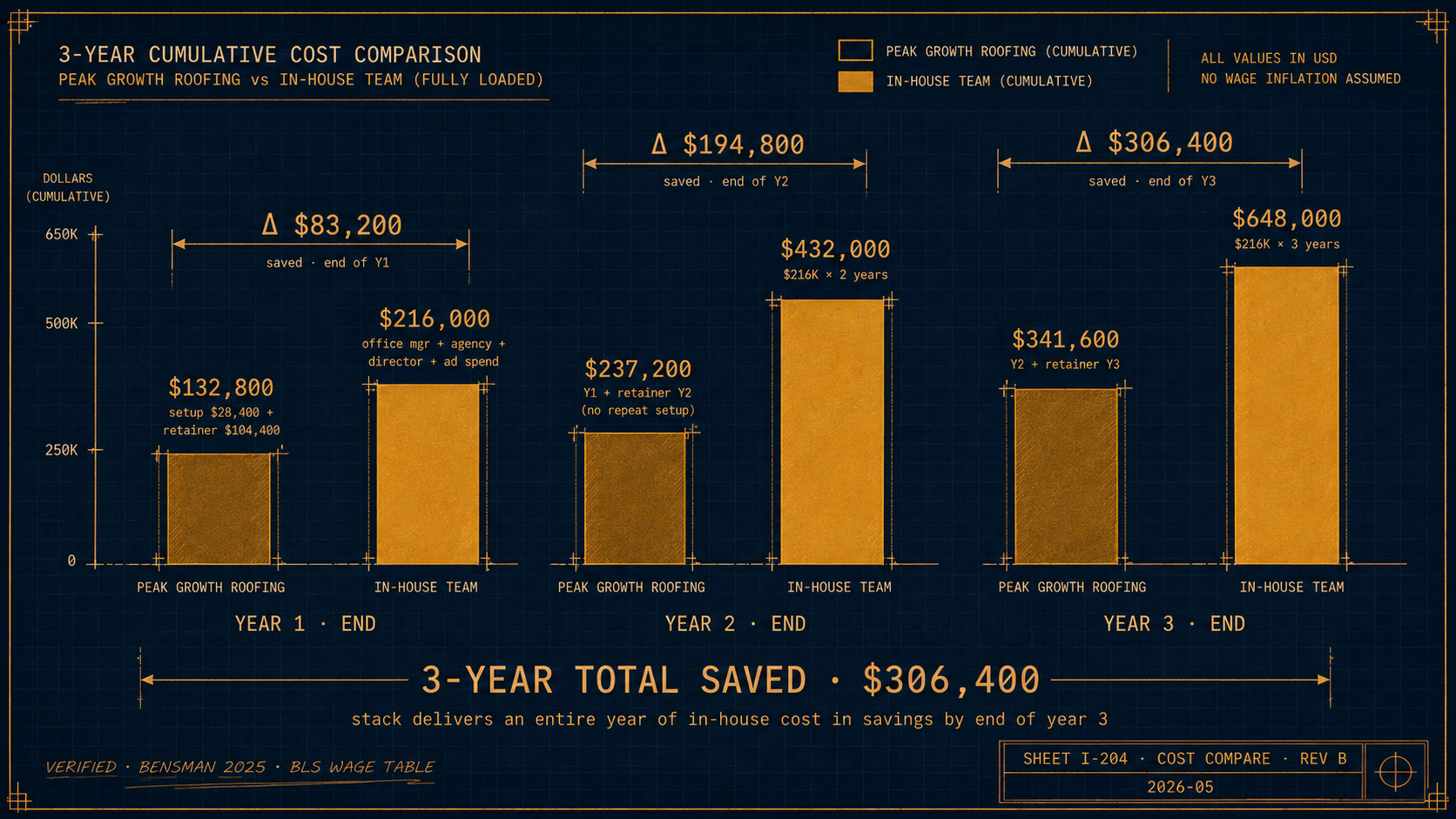
Your team-replaced math, line by line
What the monthly operations fee is really competing against. Each row is a typical fully-loaded headcount cost the stack absorbs. Numbers reflect mid-market US salaries plus benefits.
$50K–$80K base + benefits
vs. $3K/mo retainer
$55K + $50K + $300/mo
front-desk role at 40hrs/wk
Combined, that's roughly $250K/year of fully-loaded headcount the stack absorbs[5] — and the people you keep on payroll are the ones actually installing roofs.
Terms
- No lock-in. We request — not require — a 90-day window from the point operations go live to let the system prove out. There is no minimum-term contract. If the engagement isn't working at any point, the cancellation terms below apply equally during that 90-day window and after.
- Cancellation: 30-day written notice from either party, at any time. Same terms during the initial 90-day window and after — no penalty, no claw-back, no surprises.
- Setup fee payment schedule: 60% on signing, 40% at go-live (typically around the 60-day mark, or at full go-live if sooner). A written progress report is delivered at each 30-day mark so you see what's been built (details above). Monthly operations begin when the first operating layer goes live, typically around the 60-day mark.
- Handoff clause: 30 days of on-call support at no additional charge when the engagement ends, plus full credential transfer and written runbook. Contractually guaranteed.
- Infrastructure — what's included vs. what's on your card. Included in the monthly operations fee: all Anthropic + OpenRouter API usage and encrypted Backblaze backup costs. Not included — billed directly to your card by the vendor: (a) the VPS — Hostinger KVM 8, provisioned in your name on day one, roughly $360/year — and (b) ad spend on Meta, Pinterest, and Nextdoor. We never touch either of those; no markup, no margin. The VPS and ad spend are the only third-party costs outside this agreement.
- Scope changes: Either party can request scope changes in writing. Quoted before any work begins. Typical integration window is two weeks from approval to implementation. No scope-creep billing.
Client obligations · what we need from your side
This is a substantial build — three parallel tracks, dozens of integrations, real engineering hours, real AI-tooling expense. To keep it moving on schedule we need a handful of things from the client side, but the build does not have to wait for them all to be ready. We can begin work before the Google Business Profile is fully claimed and before every social-media platform is set up — those become workstream items inside the build, not blockers in front of it.
What we ask:
- A dedicated company email (created under the company's name) that we share access to during the build. We use it to provision every account where possible — GBP, GA4, Search Console, social platforms, hosting — so ownership is consolidated under one address you control. You own the email at all times. Revoking our access is a one-click operation; the company's account control never depends on our cooperation.
- Access to non-email-based accounts — Zuper CRM, domain registrar, and any other system that has its own login. Either share credentials during the build or create user accounts under the company's name that we can be added to and removed from cleanly.
- A point of contact for ownership and credential handoff during weeks 1–2.
- Collaboration between your field side and our backend. Photo intake from jobs, review asks at close-out, and field-level feedback on what's working are the human inputs that make the marketing infrastructure produce real revenue. We supply the SMS workflows, intake forms, and review templates; your crew supplies the photos, the asks, and the on-the-ground context the dashboard can't see from a server.
- Standing meeting cadence. Biweekly 30-minute operations calls during the first 30 days, shifting to weekly 30-minute calls once operations go live. Each meeting follows the same agenda: what got built, what's blocked, what's next.
Why timeliness matters. We'd like to begin as soon as the agreement is signed. The build runs against an internal schedule with two written progress reports — one at 30 days, one at 60 days — so what's been delivered stays visible as we go. The target is to have the operating system live and producing inside roughly 90 days from kickoff. We're not running a 40-yard dash. We are building toward a measurable finish line on a predictable cadence.
Pricing summary, said plainly
- Peak Growth Web (website foundation): $4,200 one-time — or skip if you bring your own website that can carry the optimization layer (audited at kickoff).
- Peak Growth Playbook (SEO + Google Business Profile + ten systems + Scoreboard dashboard): $15,600 one-time ($12,400 build + $3,200 dashboard) + $4,200/mo operations.
- Peak Growth Media Director: $12,400 one-time + $3,800/mo operations.
- Total one-time setup: $32,200 with Peak Growth Web, or $28,000 bringing your own website. Paid 60% on signing, 40% at go-live. Written progress reports delivered at each 30-day mark.
- Monthly operations: $8,000/mo ($3,800 PGMD + $4,200 Peak Growth Playbook Operations) — begins around the 60-day mark when first operating layer goes live, ahead of full go-live at Day 90.
- All-in option: take all three products at signing and save 10% on setup and monthly — $28,980 + $7,200/mo (BYO website: $25,200 + $7,200/mo). Doesn't stack with multi-location discounts; take whichever is larger.
- Recommended ad budget: minimum $2,000/mo floor, then scale as a percentage of gross revenue (industry benchmark 5–12%). Paid direct to platforms on your card. No markup.
Ad spend is direct to platforms — no agency markup. Peak Growth Web is the website foundation; the Peak Growth Playbook is the SEO / local authority / dashboard / ownership layer; PGMD is the agentic media / content-intelligence / social layer. Together they form one complete operation, built around a single front door.
Owned authority, not rented marketing. One bill. One throat to choke. Every credential in your name. Peak Growth Roofing · investment posture
Every credential. Every byte. Every post.
This is the piece no other agency offers. If our relationship ends tomorrow — for any reason — you keep everything. The domain. The codebase. The hosting. The database. The server. The Google Business Profile. The analytics. The social accounts. The agents. The dashboard. The runbook. You can hand it all to any competent developer and keep running without a missed post.
| Asset | Owner | Notes |
|---|---|---|
| Domain | You | Registered under your account; DNS records in your name; transferable any time. |
| Code repository (GitHub) | You | Owned by your GitHub organization; we hold collaborator access (revocable in one click). |
| Hosting / deployment (Vercel) | You | Vercel project under your account; we are an invited team member. |
| Database (Supabase) | You | Supabase project under your account; direct read access to every row, every table. |
| VPS (Hostinger KVM 8) | You | 8 cores · 32 GB RAM · 400 GB storage · provisioned under your account, admin access day one. |
| Google Business Profile | You | Owned by your Google account; we're added as manager (removable in one click). |
| GA4 / Search Console | You | Properties under your Google account; we have user-level access; data is yours. |
| Social accounts (FB · IG · Pinterest · Nextdoor) | You | FB Business Portfolio, IG Business, Pinterest Business, Nextdoor Business — all under your accounts; we are authorized admin. |
| Automations & agents | You | Paperclip + Hermes runtime + 8 agents on your VPS; configs are plain text in your repo. |
| Content archive + Obsidian KB | You | Plain Markdown on your VPS; nightly encrypted backup to your Backblaze B2 account. |
| Credentials map | You | Single source-of-truth document — every account, every key, every owner. Updated continuously. |
| Runbook | You | Written documentation of every component, every schedule, every recovery procedure. Hand it to any developer. |
| Dashboard + audit log | You | Self-hosted under your subdomain; magic-link auth tied to your business email; full read access to every action taken on your account. |
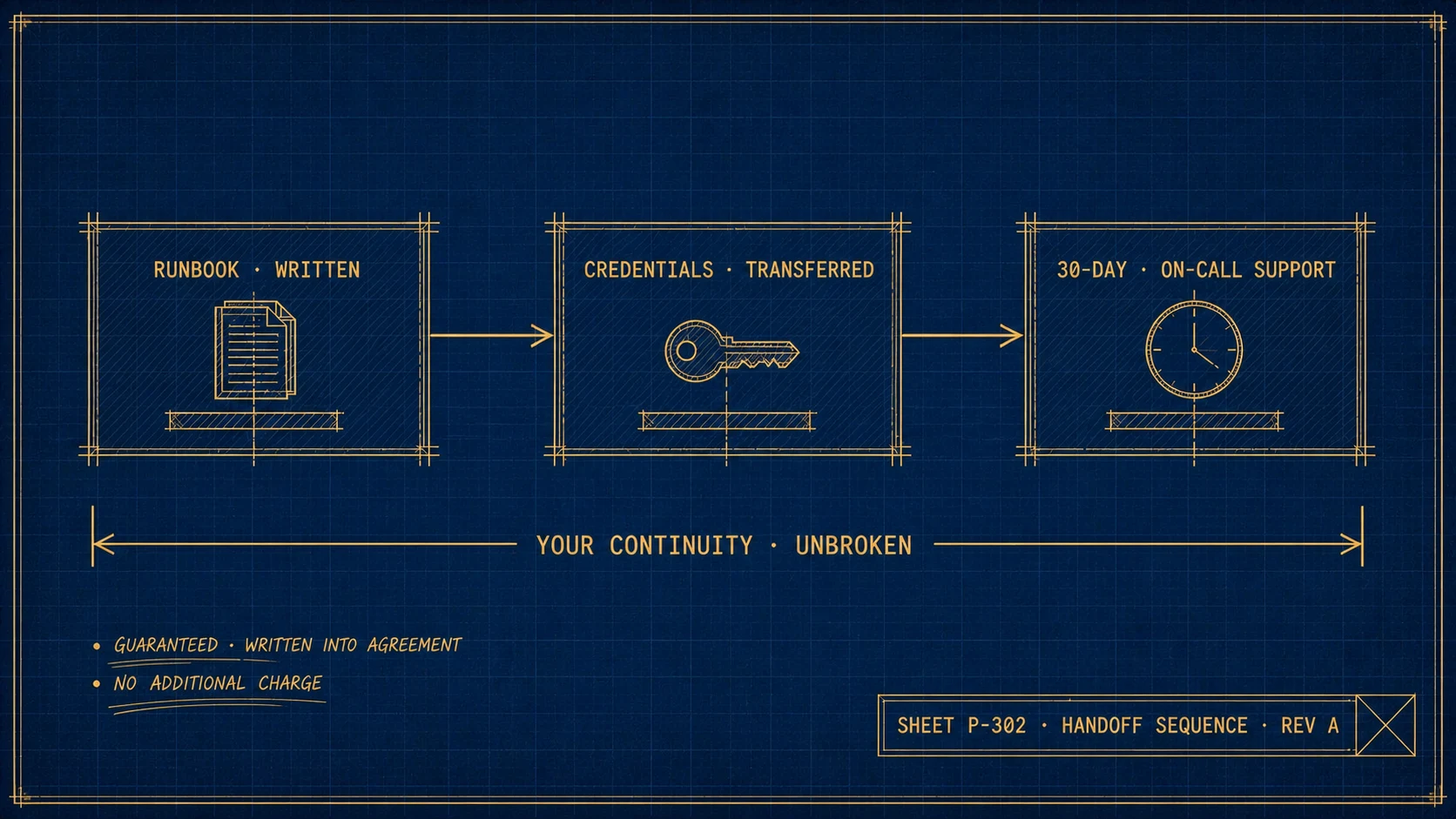
Written into the agreement explicitly: if we ever stop servicing your account for any reason, we deliver (1) a complete written runbook covering every component, every credential, every schedule; (2) full access transfer of every credential to your business email; (3) 30 days of on-call handoff support at no additional charge. That's the safety net made contractually explicit. Almost no agency in the country offers this.
You keep the keys. Ownership posture
Two disciplines, one service area, zero overlap.
If you already have an SEO and Google Ads partner, they keep what they have. Peak Growth Roofing handles the brand-authority and local-visibility layer that traditional SEO/PPC agencies don't ship. Clear division of labor, shared data, no political turf.
- Google Ads campaign management
- LSA (Local Services Ads) management
- Technical search and backlink building
- Paid-search creative and audience targeting
- Brand authority (social presence, content research, AI-discovery readiness)
- Local visibility (Google Business Profile, citations, reviews)
- Paid social (Meta, Pinterest, Nextdoor)
- Website + SEO/AEO/GEO/AIO infrastructure
- Strategy across all 14 channels of the playbook
Shared signals. Social performance, paid-social attribution, and review velocity feed back into your SEO partner's reporting. Shared calendar on seasonal campaigns. The two operations reinforce each other on the same homeowner's purchase decision instead of competing for credit.
If you don't have an existing SEO partner, we can scope that into the Peak Growth Playbook tier — but that's a separate decision from this proposal, not bundled.
How we bill, vs. where the industry is heading.
Many marketing agencies are shifting to percent-of-sales billing. We don't.
Flat monthly operations, transparent ad spend, no markup. You see the math. Billing posture
How this gets built. The honest sequence.
Three build tracks running in parallel, roughly 6 to 8 weeks each, followed by a calibration phase. Peak Growth Web, the Peak Growth Playbook, and Peak Growth Media Director — built simultaneously, not stacked. The Gamified Dashboard layers on at the end, once the source systems above are producing data the dashboard can read. Complex integrations get hooked up properly; each system locks into the next in the order they have to be wired. We're not running the 40-yard dash. We're building for the new season.
Approve Complete Stack scope
Sign the agreement covering Peak Growth Web + PGMD + Peak Growth Playbook. One conversation, one signature, all setup fees billed. Kickoff scheduling follows directly.
Confirm ownership accounts
Week 1. Inventory: domain, GitHub, Vercel, Supabase, GBP, GA4, Search Console, Zuper CRM, social. Identify any missing access. The credentials-map document begins here and stays current for the life of the engagement.
Begin Peak Growth Web build
Weeks 1–6 (parallel track). Next.js 16 production site provisioned in your name. SEO/AEO/GEO/AIO infrastructure, schema entity graph, AI-bot allowlist, GA4 + ad-platform conversion APIs wired. SEO and AEO optimization run alongside the build — not bolted on at the end. The Web and Peak Growth Playbook tracks share a week-one start and overlap by design.
Begin PGMD install
Weeks 1–8 (parallel track). VPS provisioning in your name. Meta Developer app submitted. 8-agent team configured. Brand voice tuning. Approval queue wired. Followed by a 3-week calibration phase: week 1 every post manually inspected, week 2 every other post, week 3 spot-checks only. By end of week 11 the system is operating under the risk-tier rules.
Begin Peak Growth Playbook
Weeks 1–8 (parallel track). Google Business Profile claim and optimization from zero — the profile isn't set up yet, which is part of why each system has to be wired in the right order. Technical SEO sweep. Service-area architecture. Review engine wired. Citation campaign starts. Integrations of this depth aren't rushed into place — they're sequenced so each layer holds the next one up.
Launch dashboard MVP
The dashboard layers on after the source systems are running — it reads from GA4, GBP, Zuper, Search Console, and the AI-citation probe, so it can't go live until those are producing data. Around week 10 from kickoff: Scoreboard live in calibration mode with 6 priority modules populating — Needed-From-You, Work Log, GBP, Reviews, Leads & Attribution, Ownership Checklist. Around week 14: sales-rep leaderboard goes live to the team after the 30-day dashboard calibration window closes. Month 4: remaining modules layered in and the full 13-module set is complete.
Week 14 — first systems review
Sit-down call. Web in production. PGMD operating under risk-tier rules. Peak Growth Playbook install complete. Dashboard calibration window closing — sales-rep leaderboard going live to the team. What's built, what's calibrated, what the next 30 days look like. Monthly review cadence continues from there.
Happy to walk through any of this on a call or rework any section. Whatever makes this easier to say yes to.
Sources cited
Numbered in order of first appearance in the proposal. Inline citations above link to the entry here. Internal source documents are referenced by their path inside this repository.
- Semrush. Semrush AI Overviews Study: What 2025 SEO Data Tells Us About Google's Search Shift. December 2025. Companion measurement series from BrightEdge (industry-weighted) places AI Overviews at ~48% of tracked queries by February 2026; Semrush's 10M-keyword sample placed it at 15.7% in November 2025. semrush.com/blog/semrush-ai-overviews-study cited in Why-Now stat trio, executive at-a-glance
- OpenAI / TechCrunch. ChatGPT reaches 900M weekly active users. February 2026. (Up from 800M reported October 2025; 200M was the August 2024 milestone.) techcrunch.com/2026/02/27/chatgpt-reaches-900m-weekly-active-users cited in Why-Now stat trio, executive at-a-glance
- Roofing Contractor magazine. 5 Things Roofing Contractors Want to Know about RC's 2026 Homeowner Survey. January 2026. 11% of homeowners report AI search as a roofing-discovery channel — a channel that did not exist three years ago. roofingcontractor.com · 2026 Homeowner Survey cited in Why-Now stat trio
-
Bensman, Adam. 2025-2028 Roofing Market Report: Future Trends Every $2M+ Company Must Know, Or Get Left Behind. Roofing & Solar Reform Alliance, 2025. Distribution-controlled PDF; obtainable via theroofstrategist.com.
peak-growth-roofing/project-docs/Roofing Market Report by Adam Bensman.pdfcited in Why-Now, Peak Growth Web, Peak Growth Playbook, PGMD -
The Labor Equation, Solved. Source brief on contractor-overhead economics, fully-loaded headcount math, and the 5-minute speed-to-lead SLA framework. Anchored to Harvard / MIT lead-response-time research (Oldroyd et al., 2011).
silverloon-prj/project-docs/The_Labor_Equation_Solved..pdfcited in Why-Now (04b), Investment (team-replaced math), Labor Equation callout - Sumeru Equity Partners. Sumeru Equity Partners Invests $330 Million in JobNimbus to Revolutionize the Roofing Industry. Business Wire, November 2024. (Growth investment, not acquisition — Mainsail Partners and founders remain as continuing investors.) businesswire.com · Sumeru-JobNimbus cited in Why-Now (Pac Man consolidation)
- Reinsurance News. Verisk withdraws from AccuLynx acquisition. December 29, 2025. The $2.35B deal announced July 30, 2025 was terminated when the FTC did not complete its review by the contractual deadline; regulators flagged the combined entity's hold on Xactimate pricing data plus contractor financials. reinsurancene.ws · Verisk withdraws cited in Why-Now (Pac Man consolidation)
- Pew Research Center. Americans' Social Media Use 2025. November 20, 2025. Foundation for the channel-mix decisions in PGMD (Facebook + Instagram + Pinterest + Nextdoor; not TikTok or LinkedIn at launch). 80% of adults 30–49 use Facebook; 58% of adults 30–49 use it daily. pewresearch.org · Americans' Social Media Use 2025 cited in PGMD channel mix, Peak Growth Playbook channel 8
- Pinterest, citing comScore Media Metrix. How Women Use Pinterest for Purchase Planning — 83% of US women 25–54 use Pinterest. Pinterest Newsroom; reported via Social Media Today. socialmediatoday.com · Pinterest reach disclosure cited in PGMD channel mix
- Nextdoor Business (via Taradel). Nextdoor for Home Service Businesses — 77% of Nextdoor users are homeowners; 67% share recommendations; users are 161% more likely to be interested in remodeling and construction topics. 2025. taradel.com · Nextdoor for home services cited in PGMD channel mix, Peak Growth Playbook
- Gallo, Amy. The Value of Keeping the Right Customers. Harvard Business Review, October 2014. (Citing Bain / Reichheld research — acquiring a new customer is 5–25× more expensive than retaining one; the proposal uses 5× as the conservative floor of that range.) hbr.org · The Value of Keeping the Right Customers cited in Peak Growth Playbook 4R framework (Resell pillar)
- Hunter, Chris. The Ultimate Guide to Digital Marketing for Roofers. 2018 — the source playbook, modernized inside Peak Growth Playbook for AEO/GEO/AIO and 2026 Core Web Vitals. cited in Peak Growth Playbook
- Google — Search Quality Rater Guidelines, E-E-A-T (Experience, Expertise, Authoritativeness, Trustworthiness). 2024 update elevated experience as a ranking signal. services.google.com/fh/files/misc/hsw-sqrg.pdf cited in Why-Now, Peak Growth Web Person schema
- Schema.org — the structured-data vocabulary Peak Growth Web ships against (Organization, LocalBusiness, RoofingContractor, Service, Material, Article, FAQPage, Breadcrumb, Person). schema.org cited in Peak Growth Web Layer 02
-
IETF RFC 8288 — Web Linking. Specification used to advertise
llms.txtandllms-full.txtastext/markdownalternates from every page response. rfc-editor.org/rfc/rfc8288 cited in Peak Growth Web Layer 04 - IndexNow protocol — the Bing/Yandex/Naver/Seznam standard for instant search-engine notification on content change. indexnow.org cited in Peak Growth Web Layer 04
- Anthropic, OpenAI, Perplexity, Google — the LLM providers whose AI-search citation rules drive the AIO infrastructure (GPTBot, ClaudeBot, PerplexityBot, Google-Extended, Applebot-Extended, Meta-ExternalAgent, Bytespider, CCBot, cohere-ai). cited in Peak Growth Web Layer 03 (crawler infrastructure)
- NRCA, Roofing Contractor, Building Enclosure, Roofers Coffee Shop, Ask A Roofer, FRSA, IBHS — the trade-publication and association sources scraped daily by the Research Specialist for the content intelligence layer. cited in PGMD Research Specialist, monthly intelligence sweep
-
Peak Growth Web — internal kit documentation (HANDOFF docs, layer-by-layer specs, schema implementations).
peak-growth-roofing/peak-growth-web/cited throughout Peak Growth Web deep dive - Smith, Ethan (Graphite.io). Interview on Lenny's Podcast — The Ultimate Guide to AEO: How to Get ChatGPT to Recommend Your Business. 18-year SEO veteran ranking the AI-search shift as the second biggest disruption since Google's Panda algorithm. cited in Why-Now (this isn't only a roofing call)
- McCoy, Julia (First Movers). Multiple AEO videos — Why Your Business Will Be Invisible by 2027 and The 6-Step AEO Framework. 2027 deadline framing + the 6-step ongoing operations framework the kit's monthly AEO work is built against. cited in Why-Now (deadline) and Peak Growth Web (6-step framework)
- MIT Technology Review. AI search could break the web. October 31, 2024. Documents how AI answer engines and assistants shift user attention away from traditional websites by delivering digests directly — citing the >33% of Google sessions that end without a click, with the no-click share expected significantly higher in AI search. technologyreview.com · AI search could break the web cited in Why-Now (the deadline isn't hypothetical)
- Siu, Eric (Single Grain). How to Do AI SEO the Right Way in 2026 — AEO Tactical Checklist. The "repeated presence across multiple citation sources" principle that drives the kit's depth-of-citation strategy — listicles, FAQ surfaces, BOFU content, Reddit presence. cited in Peak Growth Web (winning on those four surfaces takes depth)
-
Peak Growth Web strategy brief — GEO Ranking Signals: From Rankings to Selection. Synthesizes the AI-search shift from competitive ranking to eligibility-based selection.
peak-growth-roofing/peak-growth-web/docs/strategy/geo-ranking-signals.mdcited in Peak Growth Web (the new game is selection, not ranking) -
Hook Agency. Hook Agency YouTube Channel — Roofing Digital Marketing Series. 2025–2026. 21 video transcripts synthesized into a primary-source compilation covering Google Ads CPL benchmarks ($150–$250 residential, $300–$500 commercial, $70 brand-saturated market), missed-call economics (85% voicemail abandonment, $3,150 per missed call, 100× speed-to-lead multiplier), brand pricing effects ($2,000–$5,000 per-job premium from design quality), AEO/SEO content frameworks, and scale benchmarks for roofing contractors. Internal compilation:
peak-growth-roofing/project-docs/hook-agency-resources.mdcited in Why-Now (CPL benchmarks), Section 04b (missed-call math), Peak Growth Playbook (brand pricing dividend), Paid Ads channel row - Gamification research compilation — workforce productivity and sales-team performance evidence. Sources: AmplifAI, 50+ Gamification Statistics You Need to Know in 2026 (amplifai.com); BuildEmpire, Gamification Statistics You Need For 2026 (buildempire.co.uk); BeeLiked, Gamification Market Trends 2025 (beeliked.com); openloyalty.io, 26 Reliable Gamification Statistics that Impact Business in 2026 (openloyalty.io); Rocket Screens, Gamification in Sales: Boosting Results with Leaderboard Motivation (rocketscreens.com). Aggregate findings span sales-team performance (up to 3.5x with leaderboards), conversion-rate uplift (up to 50% across deployments), and leaderboard-specific outcomes (18% higher transaction value, 31% more add-on sales, 23% lower turnover). cited in Scoreboard (research-behind-the-design callout, Chapter 11)
- Ahearne, M., Pourmasoudi, M., Atefi, Y., & Lam, S.K. Sales Performance Rankings: Examining the Impact of the Type of Information Displayed on Sales Force Outcomes. Journal of Marketing, 2025. Peer-reviewed study across 27,000 salespeople from 170+ firms in 83 countries; identifiable performance rankings increase quota attainment without the turnover risk of anonymous ranking systems. journals.sagepub.com · Ahearne et al. 2025 cited in Scoreboard (sales-team rationale)
- Speed-to-lead research consolidation. Sources: ProLine, Roofing Speed-to-Lead Explained (useproline.com); Convoso, Importance of Home Services Lead Response Times (convoso.com); Scorpion, Why Speed Wins: The Critical Role of Response Time in Home Services (scorpion.co); Roofr, Mastering Speed to Lead in Roofing (roofr.com). Core findings: 5-minute response yields 21x conversion lift over 30-minute response and 100x connection-rate lift (Convoso citing Velocify); 78% of buyers choose the first company to respond (LeadAngel via Scorpion); 95% of home-services companies do not respond inside 5 minutes (Convoso citing Valve+Meter). cited in Scoreboard (penalty callout, sales-team rationale), throughout speed-to-lead framing
- GlassHouse Marketing. The Ultimate Guide for Roofers of All Sizes in 2025. glasshousepro.com · roofing leads. Close-rate benchmarks for residential roofing: inbound/referral 20–40%, third-party purchased leads 10–20%, referral leads above 50%; lead-to-appointment rate for hot inbound calls 80–90%. cited in Scoreboard milestone-arc revenue projections
- Northern Virginia residential roof-replacement cost compilation. Sources: Roof Troopers, Roof Replacement Cost In Northern Virginia: 2026 Guide (roof-troopers.com); Modernize, How Much Does Roof Replacement Cost in Virginia? (modernize.com); Nova Rooftek, What is the Average Cost to Replace a Roof in Virginia? (novarooftek.com). Working average for the Scoreboard revenue projections: $13K–$16K residential replacement; high-end metal and large-home jobs $25K–$50K+. cited in Scoreboard milestone-arc revenue projections ($14K average job value)
Internal architecture references
Not numbered cites — these are the internal Peak Growth source documents that the proposal is derived from.
-
Peak Growth Command Center Proposal v3 — the PGMD predecessor proposal that the agentic-ops sections of this stack proposal lift from.
peak-growth-media-director/project-docs/Peak-Growth-Command-Center-Proposal-v3.md -
Peak Growth Roofing Integration Plan v2 — the architecture document that defines how Peak Growth Web, Peak Growth Playbook, and PGMD lock together via shared brand voice, FAQ library, analytics loop, and image library.
peak-growth-roofing/project-docs/peak-growth-roofing-integration-plan-v2.md
For deeper sourcing on any specific claim, see the developer-facing executive summary at peak-growth-roofing/project-docs/peak-growth-roofing-executive-summary.md.
End of Peak Growth Roofing proposal. Personalization variants live at clients/<slug>/index.html (served at /clients/<slug>/, noindex); per-prospect data at peak-growth-roofing/clients/<slug>.md.